
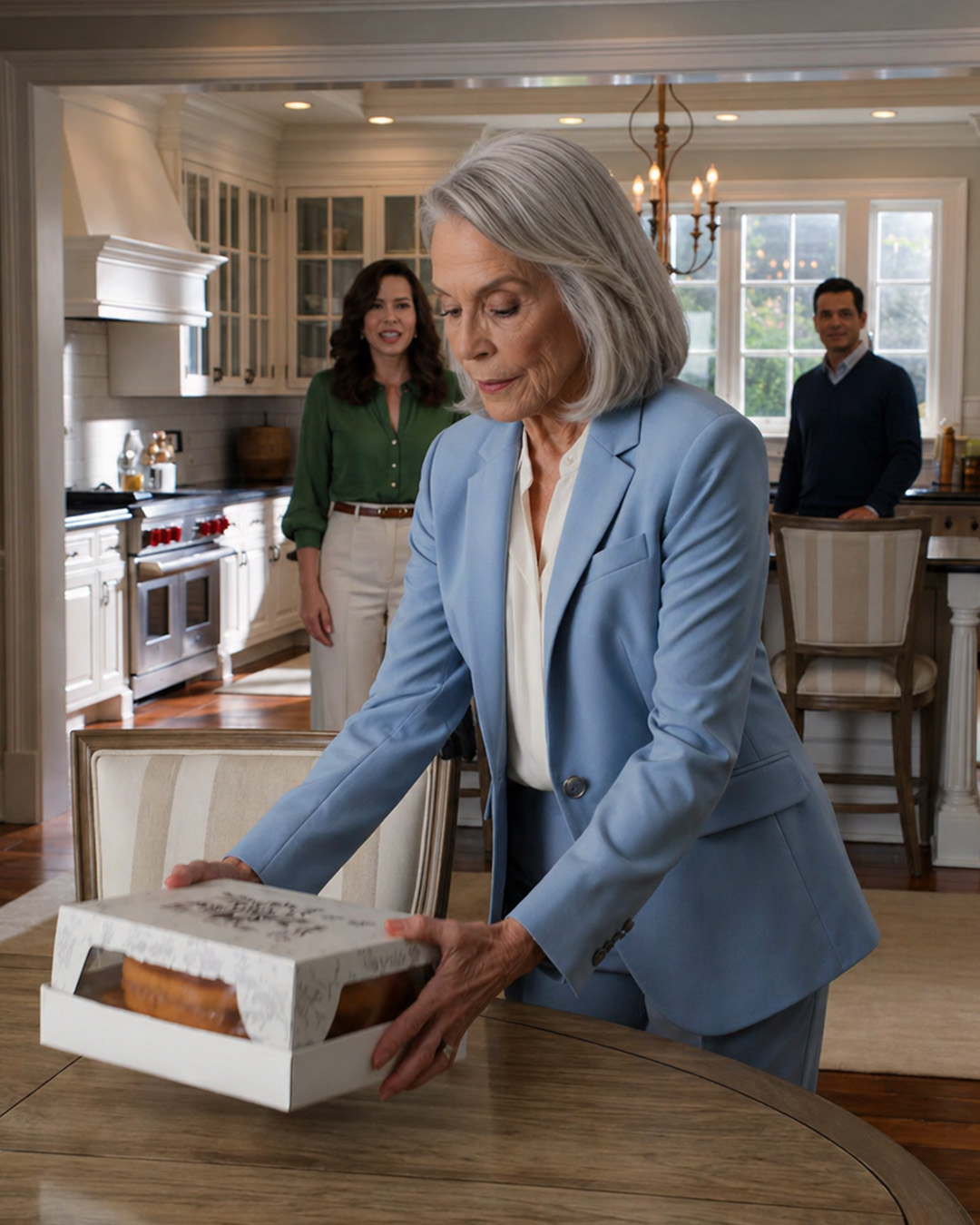
The noon sun poured over the front yard, the very same garden I had paid a landscape architect to design just six months earlier. In my hands was a heavy porcelain tray, still warm, covered with an embroidered linen cloth. Inside was my signature dish, roast pork with plum sauce, the one my son Ethan had loved since he was a little boy running barefoot through the halls of our old family home.
I froze in the doorway to the living room. My hands, spotted with age but steady from years of labor, did not tremble, though my heart tightened painfully. I was five minutes early for our Sunday lunch. I had always been punctual. My father used to say being on time was the courtesy of decent people, and I made it the golden rule of my company.
For forty years, I had served governors, organized weddings for the elite, and managed kitchen crises with the composure of a general. I was not the kind of old woman who sat knitting while waiting for life to pass. I was the kind who built an entire career from a tiny kitchen with two gas burners. But as I stood before the oak door of my son’s home, I suddenly felt small, as if every achievement had vanished beneath the scorn of a thirty-year-old woman who had never washed a single plate in her life.
“I can’t stand her, Ethan,” Madison’s sharp voice echoed from inside. “Always lecturing me with those old-fashioned morals, judging every speck of dust, bringing greasy food. I just want a peaceful Sunday. I don’t want her here breathing the same air as me.”
A heavy silence followed. I waited for my son’s voice, for one word of defense, something like, Don’t say that. She’s my mother.
But all I heard was his weak reply.
“Keep your voice down, honey. Mom’s coming. It’s just lunch. Try to get through it.”
His pleading tone, from the same son who once spoke with confidence, made my blood run cold. I adjusted my glasses, smoothed my silk dress, and took a deep breath. The scent of jasmine perfume mixed with the bitter smell of betrayal.
I decided right then that they would not see me cry. I would not turn around and leave. I would walk in, head held high, my dignity intact, because this house, though they believed it was theirs, stood on the foundation I had built with my savings and my generosity.
I pushed open the door and entered with the practiced smile I had perfected over the years, a steel smile, the same one I had used to handle demanding clients and dishonest suppliers.
“Good afternoon, everyone,” I said cheerfully, pretending I had not heard a word of the venom that had just filled the air. “It’s scorching out there, but I brought your favorite dish, Ethan.”
The living room looked like a scene from a glossy furniture catalog gone cold. Madison stood beside a gleaming white leather sofa, her face flushed, arms crossed. When she saw me, her eyes widened, then narrowed with barely concealed dislike. She smoothed the skirt of her designer dress, no doubt a weekend purchase, and forced out a brittle smile.
“Oh, Mrs. Emily, what a surprise,” she said, her sweet tone laced with poison. “I thought you were resting today. You looked so tired last week.”
“Tired? Not at all, dear,” I replied, placing the tray on the glass dining table. “At my age, rest comes after I’m in the ground. Besides, I couldn’t let Ethan miss his favorite meal.”
Ethan stood there pale-faced, avoiding my gaze, fiddling with his keys. He stepped forward and gave me a quick kiss on the cheek, a cold, perfunctory gesture.
“Hi, Mom. Thanks for coming,” he mumbled, glancing at his wife as if seeking permission to speak to his own mother.
We sat down at the table. The air was so thick it could have been cut with a knife. Madison poured water with sharp, exaggerated movements, the glasses clinking together. I looked around at the abstract paintings, velvet curtains, and crystal chandelier. All of it had come from my hard work.
When they married five years ago, Madison insisted on living in this upscale neighborhood. Ethan had just started his career as an architect and did not yet have the credit. I was the one who placed the down payment, the one who co-signed the loan. I even gave them a company credit card for necessary expenses.
“So, what have you been up to this week, Mrs. Emily?” Madison asked with a mocking smile as she speared a piece of meat. “Watching TV, gossiping at church with your old friends must be boring, not having anything useful to do.”
I recognized the jab. She knew perfectly well I still served on the neighborhood board and mentored young entrepreneurs, but she wanted me to feel irrelevant.
“Not exactly, Madison,” I said calmly, dabbing my mouth with a cloth napkin. “I reviewed some financial reports. Numbers never lie, and they never betray.”
Madison let out a sharp laugh.
“You should relax and let us live our own lives. You still think you can boss us around just because… well, you know.”
“Because what?” I asked, meeting her eyes.
“Because you’re Ethan’s mother,” she replied, stepping back slightly before regaining her composure. “But he’s an adult now. He has his own family. You’re just a guest, and sometimes too many visits can be exhausting.”
Ethan choked on his water.
“Madison, stop it.”
“What? I’m just being honest. I’m tired of pretending. Your mother acts like she owns the place, bringing food like I can’t cook, judging everything she sees. I need my space. She needs to know her place.”
The truth hung in the air, ugly, bare, and final. It wasn’t just dislike. She saw me as an obstacle to her fragile little kingdom of luxury. She hated that I knew Ethan did not make enough to sustain it.
I stayed silent, chewing the meat that now tasted like ash.
“I understand,” I said softly, my voice unnervingly steady. “You’re right, Madison. Maybe I come by too often. You two need independence.”
Madison’s eyes brightened, thinking she had won.
“Exactly,” she replied, her tone sweetening with false relief. “It’s not that we don’t love you. It’s just that young couples need privacy. You’ve lived your life. Let us live ours.”
“Yes, Mom,” Ethan added, still not looking at me. “Maybe we could see each other once a month at a restaurant or something.”
That sentence tore through the last threads of my patience. My son was pushing me out of the house I paid for just to appease the woman who treated him like a walking account number. I smiled politely and excused myself to wash my hands.
As I walked down the hallway lined with photos from their European vacations, all paid for with the emergency card, I entered the bathroom, locked the door, and looked into the mirror.
The face staring back was lined with age, hair pinned neatly in a silver bun, but the eyes were sharp, burning with the same fire that had carried me through my first denied loan. It was the gaze of a woman ready for battle.
I took out my phone, opened my banking app, and navigated to the credit card section. There it was, the supplemental card in Madison’s name. The spending was obscene. Clothes, spas, restaurants, jewelry, all charged to me, paid automatically from my pension and rental income.
I had let it slide for years, wanting my son to be happy, afraid of being labeled stingy, hoping they would grow up. But when I heard, “I don’t want that old woman here,” something inside me snapped. And when something breaks, you either discard it or repair it. I was not one to discard, but I certainly was not going to keep rewarding entitlement.
I checked the latest transaction. Five thousand dollars spent at a luxury salon yesterday. A cold smile spread across my face. My heartbeat steadied like an engine coming to life. The pain was gone, replaced by clarity.
They wanted independence. They wanted me to know my place. Fine. I would show them exactly what that place was, and who really owned the ground they stood on.
I did not cancel the card right then. I never acted impulsively. It was Sunday. The bank was closed. I needed precision. One clean strike.
I washed my hands with vanilla soap, reapplied my terracotta lipstick, and returned to the table. Madison and Ethan stopped whispering when they saw me. They looked relieved, almost victorious.
“The roast is delicious, Mom,” Ethan said awkwardly.
“I’m glad you like it,” I replied softly. Too softly. “And you’re right, Madison,” I continued. “I was thinking in the bathroom and realized you’re both right. You should live your own lives on your own dime. I’ll step back, focus on myself, maybe reorganize my finances. You know, old-lady stuff.”
“That sounds perfect,” Madison said, not catching the word finances.
We finished lunch in silence. I helped clear the table, though Madison insisted the maid, whom I also paid for indirectly, would handle it on Monday. I said goodbye at the door. The sun was dipping low, casting a warm golden glow over the house. I looked at the facade, assessing its condition and value.
A solid investment, I thought.
“See you soon,” I said.
“Yeah, whenever,” Madison replied, waving dismissively.
“All right, sweetheart. Take care,” I said with a smile.
I got into my gray sedan, simple, strong, reliable, and drove slowly out of the gated community. The security guard at the gate greeted me by name with more respect than my son had shown in years.
On the road home, it was just me and my resolve. Sunday was ending. Monday was coming, the day the real world turned. Monday was when offices opened, signatures were processed, and supply lines were cut.
They wanted the old woman gone. What they did not realize was that the old woman was the backbone of the world they lived in.
When I got home, I slipped off my shoes and brewed a cup of hot tea. Sitting in my favorite armchair, I looked at the clock. Fourteen hours until the bank opened. Fourteen hours before Madison discovered her black card was nothing more than a piece of plastic. Fourteen hours before reality came knocking, and this time it would not be bringing roast pork.
I smiled faintly as the steam curled up from my cup. They say revenge is a dish best served cold, but justice is always served on a Monday morning.
The next morning was unnervingly clear, the kind of calm that comes before a storm. I woke at five a.m., just as I had for forty years. My body kept its own time, unaware of retirement, unfamiliar with self-pity, and utterly intolerant of insolence.
While the city still slept, I brewed my coffee black, no sugar, bitter as the truth that awaited. I no longer went to the office every day. The company’s day-to-day operations were handled by my general manager, and I only stepped in when my signature was needed.
Instead, I entered my study, the room my children once called the bunker. I opened my laptop, the glow of the screen illuminating my hands on the mahogany desk. That desk had seen me cry when my husband died, laugh when I landed my first government contract, and calculate payroll through sleepless nights so I would not have to lay anyone off during hard times.
Now it would witness a family audit.
In front of me was a neatly labeled stack of files, as organized as a military dossier. I took the one marked Ethan’s household and opened it. The scent of old paper mingled with coffee. As I reviewed the detailed statements, I saw more than financial exploitation. I saw a written record of my own blindness.
It wasn’t just the credit card.
I logged into my bank account and began adding it up. Their health insurance, paid by me. The insurance on Ethan’s truck and Madison’s SUV, paid by me. The property taxes, the HOA fees, even the paycheck of the guard who greeted them each morning. All of it came from my pocket.
A chill ran down my spine, not from the air, but from the cold precision of numbers. Over the past five years, I had poured out a small fortune to keep that illusion alive. Madison wasn’t just living in a house she could never afford. She was living an entire life she had never had to earn.
I looked at the most recent charges. Forty-five hundred dollars at a spa. Eight thousand two hundred at a boutique. Thirty-eight hundred at a luxury steakhouse. The last transaction happened the very same day she claimed she was too tired to call me.
But the real treasure lay deeper in the safe, hidden behind a framed landscape painting. I turned the combination, my father’s birth date. The lock clicked softly.
Inside, I pulled out a dark blue leather folder.
Inside it was a notarized file labeled Contract Number 45890.
My fingers brushed the paper. It had been a long time since I had read it. I remembered the day I signed it at the law office. Ethan had been so thrilled he barely skimmed the details. Following my old lawyer’s advice, I had purchased the house in a very particular way. Full ownership remained in my name. Ethan only held a temporary occupancy lease, renewed annually.
And Clause Number Seven, written in small but legally binding print, stated clearly: the owner reserves the right to terminate this agreement at any time if the occupant violates principles of morality, respect, or causes damage to the property.
I smiled a sad but powerful smile.
Respect.
Would yelling, “I don’t want that old woman here,” count as disrespect?
I believed it would.
I poured myself a second cup of coffee and sat down in my reading chair, the folder resting on my lap. I closed my eyes and let myself feel the weight of the years. How had I ended up here? When did the woman who used to bargain for wholesale meat at four in the morning become the old lady treated like a burden?
I remembered my hands thirty years ago, burned by oil, nails chipped, skin cracked from industrial soap. I remembered Ethan as a boy sitting on a soda crate while I cooked for three hundred wedding guests. I had worked so that he would never have to live like that, so he could study, build a name, have a clean shirt and smooth hands. And I succeeded. He became an architect.
But somewhere along the way, I erased from his mind what effort truly meant. I had deprived him of the understanding that money doesn’t grow on trees. It comes from sweat.
As for Madison, she was another story. When she looked at me, she saw only wrinkles, silver hair, and low heels. She thought my life revolved around church services and television dramas. She had no idea that just last week I had signed a catering contract for three new industrial cafeterias. She didn’t know I managed an investment portfolio that would make her own father blush.
To her, I was nothing more than an antique with a checkbook.
That contempt, I suddenly realized, was my greatest advantage. They thought I was weak because I was old, foolish because I was generous, dependent because I sought affection. How pitiful. They did not understand that the patience of a woman who built an empire was not weakness. It was strategy.
I endured not because I could not react, but because I hoped they would grow up. But as my grandmother used to say, if there’s no seed, nothing will ever grow.
I stood and walked toward the tall mirror in my study. The woman reflected there was no longer the one who had felt humiliated yesterday. I saw an owner, a mother ready to administer the bitter medicine that saves the patient.
“It’s over, Emily,” I said out loud. My voice was firm, resonant in the empty room. “The era of handouts is over. The five-star hotel is closed. Welcome to real life.”
I turned back to my desk. It was time to make a plan.
This couldn’t just be anger. It had to be a lesson. If I cut them off all at once, they would play the victims. They would tell everyone the old woman had lost her mind. I needed a precise strike, subtle and deliberate, forcing them to face reality where it hurt most, their comfort and their pride.
I took a blank sheet of paper, uncapped my fountain pen, and began a list.
One, supplemental credit card: cancel immediately.
Two, cleaning and gardening services: stop payment.
Three, luxury utilities, premium cable, high-speed internet, club memberships: cancel or transfer contracts to their name.
Four, the final blow: the house. Review the lease agreement.
The landline rang. It was my assistant, Lucia, who had worked by my side for fifteen years.
“Good morning, Mrs. Emily. Are you coming to the office today? We need your signature for the dairy supplier contract.”
“Good morning, Lucia,” I replied, my tone oddly light. “I’ll come by later, but first, I need a favor.”
“Yes, ma’am.”
Continue reading by clicking the button (Continue Reading »») below!