
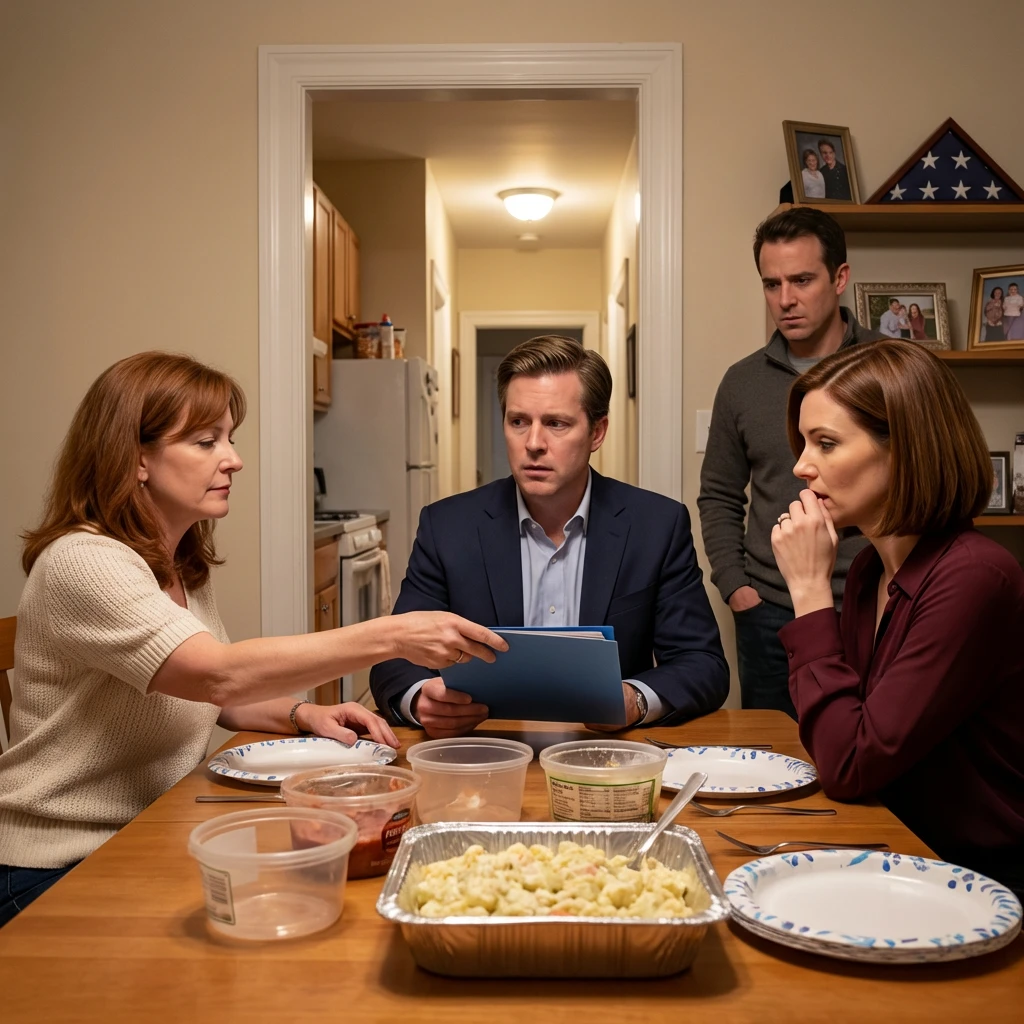
He reheated the store‑bought sides, set out paper plates because he forgot to run the dishwasher, and opened a premade pie he’d grabbed from the bakery section.
He didn’t ask me to help.
He didn’t have to.
I’d already done my part.
Sunday at five, Lydia walked through the door, sniffed, and stopped cold.
Which brought us right back to the potato salad.
—
Lydia stared at the table, then at Luke, then at me.
“Let me get this straight,” she said slowly. “You got a promotion, told your wife she was freeloading, split the accounts, and now you’re serving deli turkey as a victory dinner?”
Luke’s jaw clenched. “That is not what I said.”
“Actually,” I cut in, “that’s almost word for word.”
He shot me a warning look. Lydia caught it.
“Oh my God,” she breathed. “You really did say it.”
Her husband, David, cleared his throat. “Maybe we should just—”
“No,” Lydia said, holding up a hand. “I want to be very clear here. You and Mom have been in my ear for months about how Megan doesn’t appreciate you enough, how she spends your money, how she’s ‘just a teacher.’ And meanwhile…” She swept an arm around the apartment. “Who do you think has been keeping your life from falling apart? The laundry fairy?”
Luke opened his mouth, then closed it.
Lydia turned to me. “Is this why you’re not cooking?”
I met her eyes. “We decided to go fifty‑fifty,” I said. “So I stopped doing the hundred percent I was doing without credit.”
She stared at me for a long beat.
Then she laughed once, short and sharp. “You know what?” she said, turning back to her brother. “David, grab the wine. We’re heading back to the suburbs. I am not sitting here and letting my brother pretend he’s some hero for buying cold cuts when his wife has basically been running his entire life.”
“Lydia, come on,” Luke protested. “Don’t make a scene.”
“You already made it,” she said. “I’m just refusing to applaud.”
She stepped close enough to kiss my cheek. Her voice dropped. “You deserve better than this,” she murmured.
Then she was gone, the front door shutting with a soft but final click.
The apartment felt bigger with just the two of us and the plastic containers.
Luke stood frozen in the middle of the living room, fingers tight around the neck of the unopened wine bottle.
“I can’t believe she walked out,” he said.
I could.
I walked past him into the second bedroom and came back with a blue folder.
I set it on the table between the potato salad and the cardboard pie box.
“What’s that?” he asked.
“Six years,” I said.
He frowned. “Six years of what?”
I flipped the folder open.
“Six years of statements,” I said. “Six years of tutoring invoices. Six years of receipts. Six years of what you didn’t see.”
The first page was a simple summary I’d printed out the night he told me the freeloading ends today.
Total classroom salary deposited: X.
Total tutoring income deposited: just under $400,000.
I watched the number land.
“Four hundred thousand dollars,” I said quietly. “That’s what I’ve put into our accounts from evenings and weekends while you were at happy hours and golf outings and leadership retreats. That doesn’t include my teaching salary. That’s just the ‘extra.’”
He stared at the paper like it was written in another language.
“That can’t be right,” he whispered.
I flipped to the next section. Housing.
“Rent,” I said. “Utilities. Internet. Over six years, I paid roughly forty‑eight thousand more than half. Because you were paying off your car. Or your student loans. Or your credit card. I didn’t complain. I figured we were a team.”
His shoulders began to sag.
“Groceries, household supplies, gifts for your family, holidays, birthdays,” I went on. “Roughly thirty thousand. That includes the Thanksgiving your mom ‘hosted’ two years ago and I quietly paid for half the catering.”
He looked sick.
“And then there’s the unpaid labor,” I said.
I slid one more page forward.
“Fifteen hours a week of cooking and cleaning,” I read. “Ten hours a week of scheduling, appointments, planning trips, remembering birthdays, sending cards, ordering gifts, managing repairs. Conservatively. If I charged even twenty dollars an hour—which is less than my tutoring rate—you’re looking at nearly two hundred thousand dollars’ worth of work.”
The silence that followed wasn’t dramatic.
It was heavy.
Luke sank into a chair. The bottle of wine clinked against the table.
“I didn’t know,” he said.
“No,” I replied. “You didn’t look.”
He stared at the pages spread out like evidence.
“I thought…” He swallowed. “I thought I was carrying everything. The rent, the future, the responsibility. Mom kept saying I was doing it all.”
“Your mom saw your pay stub,” I said. “She didn’t see the spreadsheet.”
He dropped his head into his hands.
“What do you want from me?” he asked after a minute. “You want me to apologize? To go back to a joint account? To—”
“I want to be seen,” I said.
He lifted his head.
“For six years, I made your life possible,” I said. “I let you chase promotions because someone had to make sure there were clean shirts and paid bills and birthday presents. I didn’t resent it. Not at first. I thought we were building something together. But when you called me a freeloader, you made it very clear you’d never even bothered to notice.”
His eyes were wet.
I didn’t reach for him.
The numbers could do their work.
—
That night, his phone rang.
He hit speaker without looking.
“Hey, Dad,” he said, voice rough.
Richard’s voice came through the small apartment like it was sitting in our living room. “Your sister just left here fuming,” he said. “You want to tell me why my daughter‑in‑law is apparently a freeloader now?”
Luke closed his eyes. “Dad, I don’t—”
“I remember who planned every holiday, every birthday, every trip,” Richard cut in. “It wasn’t you. It wasn’t your mother. It was Megan. I remember the night I ended up in the ER and you panicked about taking time off work, and Megan booked all the flights and hotels and dealt with the insurance.”
He paused.
“You lived comfortably because your wife paid with her time and her money,” Richard said. “And you never noticed. That’s not partnership. That’s entitlement.”
“I didn’t mean to hurt her,” Luke said quietly.
“Intent doesn’t erase damage,” his father replied. “If you want to keep this marriage, you’d better start valuing what you have before it walks out the door.”
The call clicked off a moment later.
Luke stared at the darkened screen.
For once, he didn’t get defensive.
He just looked small.
—
Here’s the part where I’m supposed to say he woke up the next day a changed man.
He didn’t.
What he did wake up as was a confused one.
He tried to fix things the way he fixed problems at work—make a list, schedule a meeting, send an email. Only this wasn’t a budget reconciliation or a project timeline. This was six years of me carrying the invisible and him being proud of not seeing the weight.
The next week, he started doing the chores he’d never done before.
He loaded the dishwasher and forgot to scrape plates first. He vacuumed and caught the cord under the wheels so many times the machine actually gave up and died. He tried to cook eggs and ended up with a blackened mess welded to the pan.
“I don’t understand how you did all this and worked full‑time,” he said one night, standing in the doorway while I wiped down the counter after making myself a simple dinner.
“I didn’t have a choice,” I said.
He leaned against the frame, looking more tired than I’d ever seen him after a day of meetings.
“Everything feels heavy,” he admitted.
“Welcome to my side of the marriage,” I said.
I wasn’t cruel.
I was honest.
He started taking the spreadsheet seriously.
One night, I came home from a late tutoring session and found him at the table, laptop open, receipts spread out in front of him. His hair was a mess. His tie was gone.
“This is all of it?” he asked, gesturing at the screen.
“For this month,” I said.
He scrolled down slowly.
“Rent. Groceries. Utilities. Car maintenance. Dinner with your boss. Birthday gift for Mom. Cleaning supplies,” he read. “It’s…” He shook his head. “It’s a lot.”
“It always has been,” I said.
He was quiet a long time.
The next morning, he slid three sheets of paper across the table to me before heading to work.
“What’s this?” I asked.
‘Een lijst,’ zei hij. ‘Van alles wat ik me kan bedenken dat je de afgelopen zes jaar hebt gedaan en wat ik nooit heb opgemerkt. Vluchten. Vakanties. Mijn moeder naar haar colonoscopie brengen. Bij mijn vader zitten tijdens zijn herstel. De verjaardagscadeaus voor mijn nichtjes op tijd versturen. Bijhouden wanneer mijn rijbewijs verliep. Ik begon te schrijven en ik kon niet meer stoppen.’
Ik heb de pagina’s gescand.
Het was niet compleet.
Het was een begin.
‘Ik had het mis,’ zei hij zachtjes. ‘Ik was blind.’
Voor het eerst sinds zijn bezoek aan de bank gebruikte hij ‘ik’ in plaats van ‘wij’.
—
Er gingen zes maanden voorbij.
Het appartement veranderde niet ineens in een Instagram-waardige, perfecte woning. Er waren nog steeds avonden dat hij vergat het vuilnis buiten te zetten, en dagen dat ik onbewust terugviel in oude gewoonten.
Maar het evenwicht verschoof.
Hij maakte zijn eigen boodschappenlijstjes en leerde welke groenten een week goed bleven en welke in de groentelade tot een soort drab veranderden. Hij behandelde de wasmand niet langer als een zwart gat. Hij begon zelf afspraken bij de tandarts te maken in plaats van mij herinneringsmails door te sturen met de vraag: “Kun jij dit even regelen?”
We hielden de rekeningen gescheiden.
We hebben ook het spreadsheet bewaard.
Het voelde niet langer als een wapen, maar als een spiegel.
Op zondagmiddag openden we het aan tafel met echt eten, eenvoudige dingen die we samen hadden gekookt. We werkten de lijst af, regel voor regel.
‘Hebben we dit abonnement nog wel nodig?’, vroeg hij dan.
‘Waarschijnlijk niet,’ zou ik zeggen.
“Heb je echt zoveel geld uitgegeven aan lesmateriaal?”
‘Ja,’ zou ik antwoorden, ‘omdat de school niet dekt wat mijn leerlingen nodig hebben.’
Hij deinsde niet meer terug toen ik zei: mijn studenten.
Hij respecteerde dat mijn werk niet ophield toen de bel ging.
Op een zondag kwam Patricia langs.
Ze kwam deze keer niet binnenstormen alsof ze de eigenaar was. Ze ging tegenover me op de bank zitten en vouwde haar handen in haar schoot.
‘Ik ben je een verontschuldiging verschuldigd,’ zei ze.
Ik keek op van de mok thee die ik vasthield. Luke stond in de keuken de afwas te doen. Hij stond stokstijf te luisteren.
‘Ik heb je beoordeeld zonder te weten wat je aan het doen was,’ vervolgde ze. ‘Ik heb dingen over je tegen Luke gezegd die niet eerlijk waren. Ik heb je klein laten klinken.’
‘Dat heb je inderdaad gedaan,’ beaamde ik.
Ze slikte. ‘Het spijt me,’ zei ze. ‘Voor alles.’
Het was niet dramatisch.
Het was echt.
‘Dank u wel,’ zei ik.
Ze knikte en keek richting de keuken, waar Luke deed alsof hij gefascineerd was door de spons.
‘Voor alle duidelijkheid,’ voegde ze eraan toe, ‘je schoonvader maakte me bang toen hij jouw kant koos. Hij zei dat als Luke jou zou verliezen, dat zou komen doordat we hem hadden opgevoed met het idee dat hij nooit verder hoefde te kijken dan zijn eigen salaris.’
Haar stem brak bij het laatste woord.
Ik heb haar niet omhelsd.
Maar ik liet wel iets in mijn borst ontspannen.
—
Een paar weken later kwam Luke op een ochtend de keuken binnen terwijl ik mijn tas aan het inpakken was voor mijn werk.
“Mij werd een nieuwe promotie aangeboden,” zei hij.
Ik keek omhoog.
‘Gefeliciteerd,’ zei ik automatisch.
‘Ik heb geen ja gezegd,’ voegde hij eraan toe.
Dat zette me aan het denken.
‘Ik wilde eerst met je praten,’ zei hij. ‘Dat zou betekenen dat ik meer uren moet werken. Meer moet reizen. Meer geld, ja, maar ook meer… van alles.’
Meer gewicht.
Nog meer druk op het systeem dat al eens eerder was gebarsten.
“Ik wil geen succes als het ons weer geld kost,” zei hij.
Ik zette mijn koffie neer.
‘Ik heb me nooit tegen je ambitie verzet,’ zei ik. ‘Ik verzette me ertegen dat ik er onzichtbaar voor zou zijn.’
Hij knikte langzaam.
‘Als ik het aanneem,’ zei hij, ‘maken we een plan. We huren een schoonmaakbedrijf in. We budgetteren voor maaltijdpakketten voor sommige weken. We houden een spreadsheet bij. We voeren daadwerkelijke gesprekken voordat ik toezeg ‘s avonds laat of in het weekend mail. We beslissen samen.’
Ik heb hem bestudeerd.
Voor het eerst voelde het niet alsof hij een toespraak hield die hij voor de spiegel had geoefend.
Het voelde alsof hij me uitnodigde in de ruimte waar de beslissingen werden genomen.
‘En de boekhouding?’ vroeg ik.
Hij wierp een blik op de blauwe map in de boekenkast, op de randen van de pagina’s die hem ooit zo diep hadden verwond.
‘Ik zou graag weer een gezamenlijke rekening willen,’ zei hij. ‘Voor het huis. Voor ons allebei. We kunnen natuurlijk ook allebei een eigen rekening hebben. Maar ik wil niet als huisgenoten met een eigen boekhouding samenleven. Ik wil als partners samenleven die respecteren wat ieder van ons inbrengt – zowel op papier als daarbuiten.’
‘Alleen als het respect blijft,’ zei ik.
‘Dat zal zo zijn,’ antwoordde hij.
Hij zei het niet met het blinde zelfvertrouwen van een man die dacht dat geld hem gelijk gaf.
Hij zei het alsof hij zes maanden lang had moeten leren hoe duur zijn onwetendheid was geweest.
—
Continue reading by clicking the button (Continue Reading »») below!