
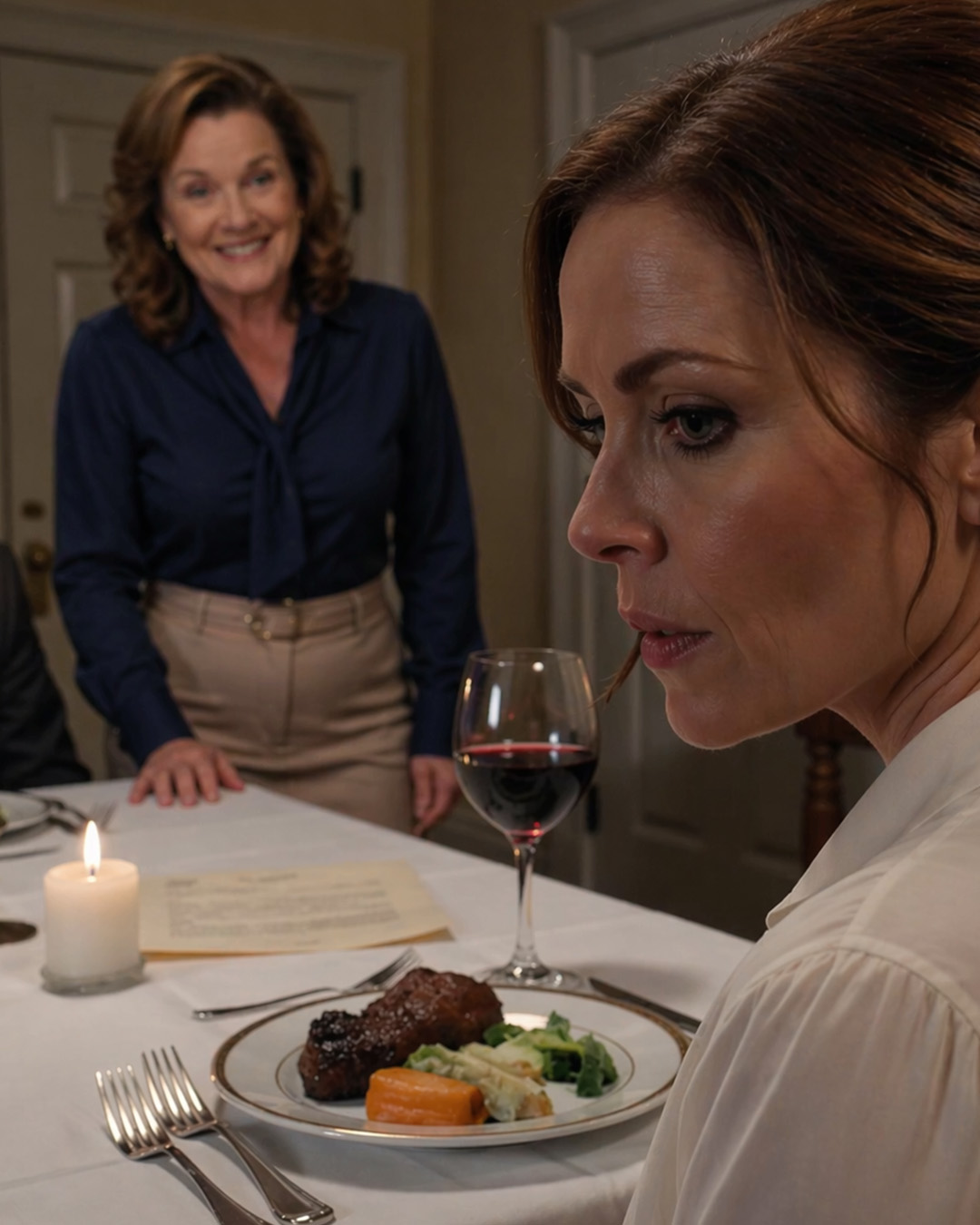
Vivien’s palm hit the table. Not hard, but the plates rattled.
“You told me Daddy didn’t leave a will. You told me that to my face. I asked you directly, and you said there was nothing.”
My mother’s mouth worked, but the words stalled.
Brin looked at me, then at her mother.
“Mom, did Grandpa Earl leave anything for you too?”
I turned to the relevant section of the will, the page Harold had flagged with a yellow tab.
Earl had left Vivien $15,000 in savings bonds. The executor, Gloria, was supposed to distribute them after probate.
I slid the page across to Vivien.
She read it, her lips pressed into a thin white line.
“$15,000,” she said. “He left me $15,000, and you took it.”
“I didn’t take—”
“You told me he left nothing, Gloria. You looked me in the eye at his funeral and said, ‘There’s nothing for any of us.’ And I believed you because you were my sister.”
The word sister landed like a stone.
Uncle Dale put his arm around Vivien’s shoulder. Brin reached for her mother’s hand.
My mother stood at the head of a table she didn’t own, in a house she’d never had the right to claim, surrounded by the family she’d lied to for 20 years.
She had no allies left in the room.
I stood up. I didn’t raise my voice. I spoke the way I’d speak to a judge. Measured, factual, respectful of the room.
“Mom, I’m not here to throw you out of this house tonight. I’m here to tell you the truth that you’ve hidden from me for 20 years.”
She gripped the back of her chair. Her eyes were wet, but the tears hadn’t fallen. They were sitting there, ready, waiting to be used. I’d seen those tears before. They were weapons, not grief.
“Here’s what happens next,” I said. “You sign the deed transferring the title to me, which is what the trust required 16 years ago. If you refuse, I file a petition with the Wake County Court for removal of trustee and court-ordered distribution. The outcome will be the same. It’ll just cost you more.”
I held up the quitclaim deed she’d signed for Ray.
“This is void. You were never the owner. You were the trustee. You had a duty, and you violated it.”
Then I laid down the last term.
“I’m willing to let you stay in this house on a lease with clear boundaries for as long as you need to sort out your next step, but the title transfers to me. That’s not a negotiation.”
“This house was Grandpa Earl’s promise to me,” I said. “You don’t get to rewrite his wishes.”
She looked at me with a fury I’d felt my whole life, but had never met head-on.
“You’ll regret this,” she said.
“I’ve spent 20 years regretting my silence,” I said. “That’s done.”
I picked up my satchel, nodded to Vivien, touched Brin’s shoulder as I passed. Then I walked out the front door, across the porch my grandfather built, and into the October night.
The air outside was cool and smelled like pine needles and someone’s chimney fire down the road. I stood on the porch, the same porch where Grandpa Earl had told me this house would be mine, and let my hands shake.
They’d been steady all through dinner, steady when I opened the folder, steady when she screamed. But now, out here in the dark, with the porch light humming above me and the crickets going full tilt, I let them go.
Brin came out first. She didn’t say anything for a few seconds, then she wrapped her arms around me and held on.
“I can’t believe she did that,” Brin said into my shoulder. “All those years.”
“She’s still your aunt,” I said. “And you’re still my cousin. That comes first.”
From inside, I could hear my mother crying. The loud, ragged kind, the kind that fills a room and demands attention.
Vivien’s voice followed, low and firm. I couldn’t make out the words, but the tone was unmistakable. It was the voice of a sister who was done pretending.
Ray’s truck was already gone. The driveway held its empty shape in the gravel.
I called Marin from the porch steps.
“How’d it go?” she asked.
“It’s done.”
“How do you feel?”
I looked at the sky through the pine branches. Stars were coming out in pieces between the clouds.
“Like I just set down something I’ve been carrying for 20 years.”
Vivien stepped outside a few minutes later. Her eyes were red, but her posture was straight.
She looked at me and said, “I owe you an apology, Ingred. I should have asked more questions.”
“You didn’t know,” I said. “Neither did I.”
She pulled me into a hug that smelled like vanilla perfume and the house I grew up in.
I know some of you are thinking she should have just let it go. And honestly, a year ago, I might have agreed with you.
But letting it go wasn’t keeping the peace. It was letting someone else write my story.
If this resonates with you, if you’ve ever had to choose between being liked and being honest, drop my turn in the comments and hit subscribe if you want to hear how this all settled. Because what my mother did in the weeks after that dinner, I didn’t see coming.
Now, let me tell you.
Two days later, my phone rang at 9 in the morning. Gloria.
I answered because I told myself I would. Whatever she threw at me, I’d take the call. I owed myself that much. The proof that I could pick up and not fold.
“I’m your mother.” Her voice was hoarse, swollen. “Doesn’t that mean anything to you?”
I waited.
“I can’t sleep. I can’t eat. Ray hasn’t called. Are you happy now? Is that what you wanted?”
“I’m not happy about any of this, Mom.”
She pivoted. I could almost hear the gears turning.
“If you take this to court, everyone in town will know. Every neighbor, the people at church. Is that what you want? To humiliate your own mother in front of everyone?”
“I’d rather we handle this between us,” I said. “But that’s up to you.”
She tried a third angle, softer now, almost gentle, the way she sounded when she really needed something.
“Your grandfather was old and confused when he wrote that trust. He didn’t understand what he was doing.”
“He was sharp enough to hire a lawyer and write a legally binding document,” I said. “And you were sharp enough to hide it for 20 years.”
She hung up.
I sat at my kitchen table for a long time after. The apartment was quiet. Morning light came through the blinds in stripes across the counter.
I poured a glass of water and didn’t drink it.
Then I opened my laptop and typed a note in the case file I’d been building.
Gloria refused voluntary compliance. Proceed with petition.
She’d spent my whole life teaching me that love meant never saying no. But love without truth isn’t love. It’s a lease. And she’d been collecting rent on it for decades.
I didn’t file the petition alone. My boss at Morrison and Grant, senior partner Catherine Grant, had heard the story by then. Marin told her.
I’d expected a polite nod and a referral.
Instead, Catherine called me into her office on a Wednesday afternoon and said, “I’ll take the case pro bono. Your grandfather set up a clean trust. This should have been resolved 16 years ago.”
The petition went to the Wake County Clerk of Superior Court on a Thursday morning. Three counts. Removal of Gloria Holloway as trustee of the Earl Puit Testamentary Trust. Court-ordered distribution of the trust asset, the house on Riddle Creek Road, to the named beneficiary. And a full accounting of the trust’s financial assets, including the $38,000 in savings that had vanished in 2008.
We attached everything: the trust instrument, the deed, Harold’s affidavit, the bank records showing the closed account.
Gloria was served the following Monday.
Vivien told me later that when the process server left, Gloria sat in the kitchen and stared out the window at the backyard for over an hour. Didn’t move, didn’t call anyone.
I didn’t celebrate.
There was nothing to celebrate. This wasn’t a victory lap. It was a correction, 20 years overdue.
I thought about my grandfather, how he’d sat in Harold Puit’s office and planned all of this, hoping it would never be needed. How he’d trusted his daughter to do the right thing and built a safety net in case she didn’t. He trusted the law to protect me, even if my mother wouldn’t.
The least I could do was follow through.
The court date was set for six weeks out, but it never got that far.
Gloria hired a lawyer, a court-appointed attorney named Dennis Webb, who specialized in family trusts. He was straightforward with her. I know this because his office sent a settlement proposal two weeks after the filing.
The proposal was simple. Gloria would voluntarily comply with the trust terms, execute a deed transferring full title to me, and agree to a structured repayment of the documented trust funds. In exchange, I would drop the petition and allow Gloria to remain in the home under a written lease agreement.
Her attorney told mine off the record that he’d laid it out plainly.
“If this goes to court, you lose, and the court record becomes public. Every detail.”
Gloria signed the deed on a Tuesday at Dennis Webb’s office in downtown Raleigh. I was there.
She sat across the table from me, signed her name without looking up, and left without a word. No eye contact, no goodbye.
The deed was recorded at the Wake County Register of Deeds that afternoon. The clerk stamped it, filed it, and handed me the receipt.
Recording fee, $26.
I held the receipt in my car for a long time. Twenty-six dollars. That’s what it cost to put my name where it should have been since I was 21.
Twenty years and $26.
That weekend, I drove to Riddle Creek Road, parked in the driveway, didn’t go inside. Gloria was still there, and the lease terms hadn’t started yet.
I just stood on the sidewalk and looked at the house. The gray shingles. The wraparound porch. The dogwood tree my grandfather planted the year I was born, its leaves turning red at the edges.
For the first time, I was standing in front of that house as its legal owner.
The feeling wasn’t triumph. It was recognition.
I let my mother stay. Some people won’t understand that. After everything she did, the lies, the stolen inheritance, the years she kept me small, I let her stay in the house.
But I didn’t do it for her.
I did it because eviction wasn’t the point. The point was the truth. The point was the line.
We drew up a lease agreement. Twelve months, rent zero. Gloria would cover utilities and basic maintenance. No modifications to the property without my written approval. No additional names on anything, ever.
She signed it the same way she’d signed the deed. Quickly, silently, like touching something hot.
The financial accounting took longer. The $38,000 was mostly gone, spent, scattered, untraceable in the way cash becomes after 20 years. But Gloria agreed to repay $22,000, the portion we could document, in monthly installments.
Continue reading by clicking the button (Continue Reading »») below!