
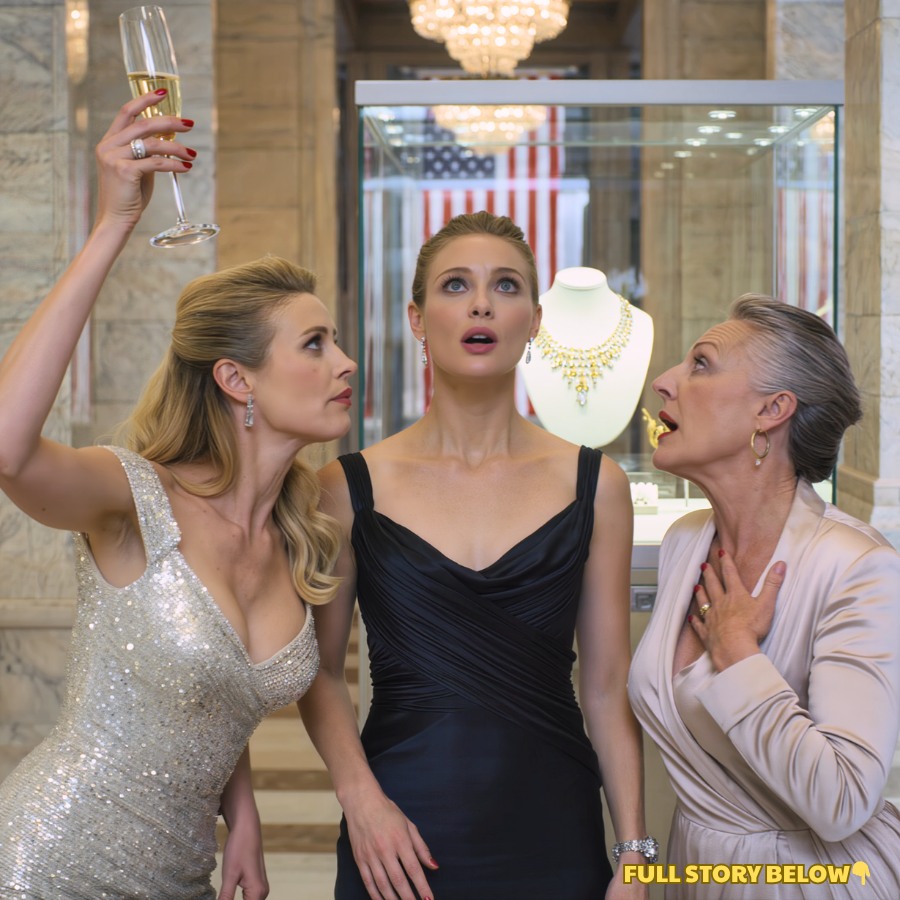
“I don’t know who I am if I’m not…” She stopped.
The old Chloe would never have admitted uncertainty out loud. That alone nearly softened me.
“Then start there,” I said. “Figure out who you are when you’re not performing above someone else.”
She let out a breath she may have been holding for years. “Do you think I can?”
“Yes,” I said. “But not if you keep needing me beneath you.”
For the first time in our lives, she nodded instead of arguing.
It was not redemption. Not yet. But perhaps it was the beginning of something human.
Months later, on an ordinary evening that looked nothing like the night of the gala, I found myself back at my apartment window after work, watching the city settle into blue dusk. I was wearing the replica necklace. I often did now. Not because it symbolized victory. Because it symbolized continuity. The real piece belonged to history and the public and the future. This one belonged to me.
On my coffee table sat documents for the foundation, notes for a preservation grant cycle, and one of Grandma’s sketchbooks opened to a page where she had drawn hands holding a chain of light. In the margin, in her tiny slanted script, she had written: What is hidden is not always lesser. Sometimes it is simply waiting for the world to become worthy of seeing it.
I read that line over and over.
Outside, headlights glittered. Somewhere far downtown, the museum roof caught the last of the sun. My phone buzzed with an incoming message from my mother—nothing dramatic this time, just a photo of a rosebush finally blooming in her yard and the words Thought of Grandma. Hope you’re well.
I answered, Beautiful. I’m well.
And I meant it.
There was no triumphant soundtrack. No final confrontation. No cinematic slam of a door. Life rarely arranges itself into endings that tidy. Instead it moved the way it always does—forward, carrying consequences, leaving some people behind, bringing others closer, teaching you by repetition what you no longer have to accept.
The gala had not magically fixed my family. It had not erased the years of contempt or transformed my mother into tenderness overnight or turned Chloe into a saint. What it had done was simpler and more radical: it changed the balance of truth. They could no longer tell the story in a way that required my smallness. I could no longer be persuaded to participate in it.
And once that happened, everything else had to reorganize.
Sometimes people still asked me, usually in interviews or over donor dinners or in the soft speculative tone strangers use when they want emotional closure from someone else’s life, whether revealing the necklace the way I did had been about revenge.
I always answered the same way.
“No,” I said. “It was about clarity.”
Because revenge still centers the people who hurt you. Clarity centers reality.
The reality was that I had been carrying something priceless while the people closest to me laughed at it from across a dinner table.
The reality was also that I had been carrying something priceless inside myself for much longer.
That was the part they failed to recognize.
That was the part I finally did.
Late that night, before bed, I stood once more in front of the mirror and touched the necklace at my throat. The replica glinted softly in the lamplight. Not the original. Not history under glass. Just gold, modest and real, resting where doubt used to live.
For years they had looked at me and seen someone easy to dismiss.
A girl with the wrong job. The wrong taste. The wrong kind of ambition. A daughter who didn’t reflect the family’s preferred story back at them in flattering light. They called me fake because it was easier than admitting they had no eye for what mattered. They called me less because they needed someone in the room to measure themselves against. They mistook volume for worth and surface for substance and performance for truth.
And I let their version of me bruise me for longer than I should have.
But not forever.
The truth, when it finally emerged, did what truth always does. It illuminated everything at once: the necklace, the room, the cruelty, the blindness, the years. It didn’t just show them what real gold looked like. It showed me.
I looked at my reflection and smiled—not the thin careful smile I used at family dinners, not the defiant one I wore on the museum steps, but something quieter. Freer.
“They thought I wore something fake,” I whispered to the woman in the mirror.
Then I touched the chain once, gently.
“Turns out,” I said, “I just hadn’t shown them the real me yet.”
And for the first time in my life, I smiled not because I had won, but because I had finally stopped needing to.
Continue reading by clicking the button (Continue Reading »») below!