
I felt cold.
“They forged documents to hire you.”
“Not forged exactly, more like they lied about what the documents meant. But yes, essentially they misrepresented their authority to hire us. If we had known they didn’t have legal permission, we never would have accepted the job.”
“Why are you telling me this?”
Patricia hesitated.
“Because I’ve been in this business for twenty years, and I know the difference between a family disagreement and something more serious. What your parents did crosses a line. You deserve to know exactly what happened. Also, frankly, we don’t want to be caught in the middle of this lawsuit. If you need any documentation from us about what we were told and what documents we were shown, we will provide it.”
After I hung up with Patricia, I sat at my desk for a long time, staring at my computer screen without seeing it.
My parents had lied to the contractors.
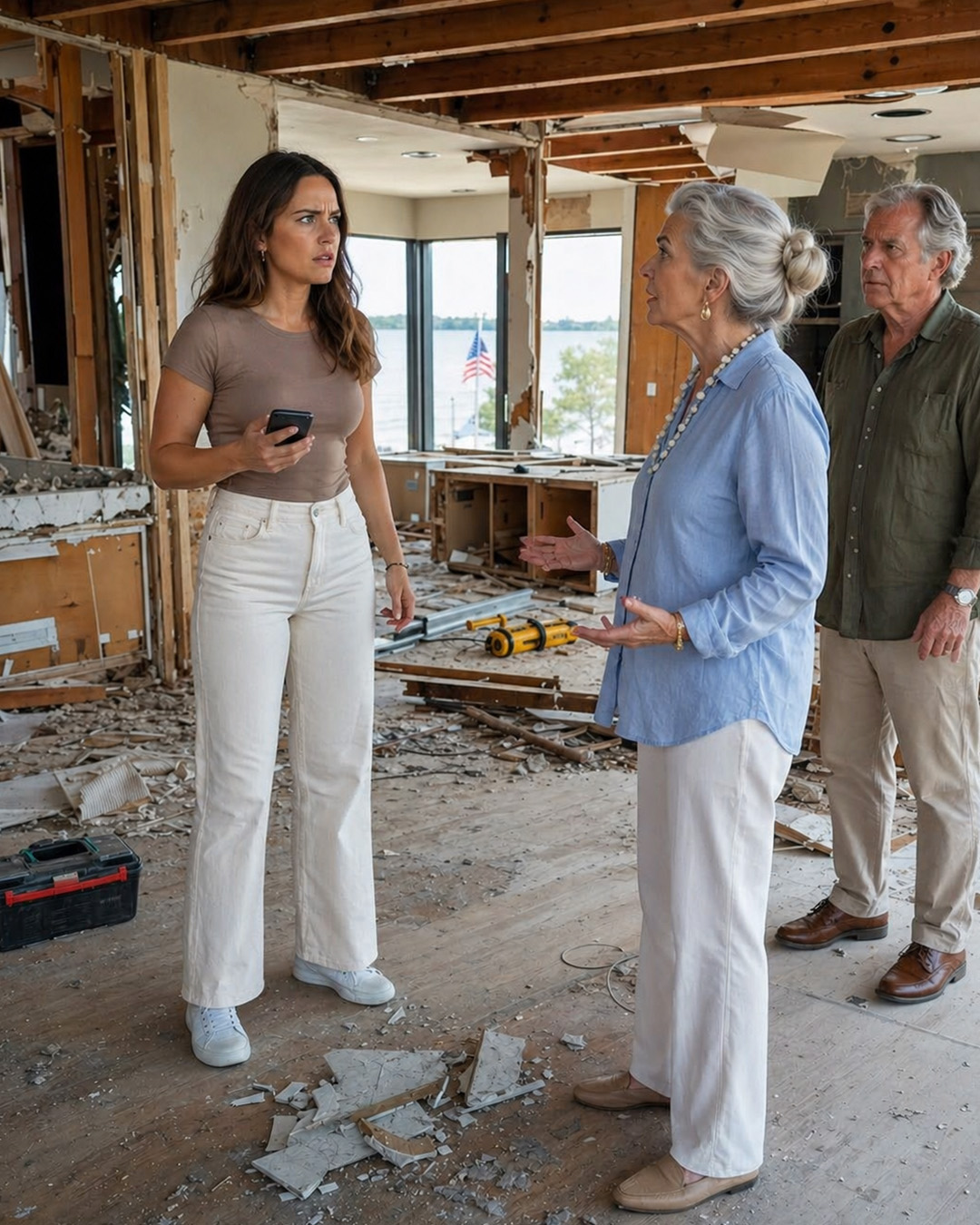
They had deliberately misrepresented documents to make it seem like they had the authority to demolish my house.
This wasn’t a misunderstanding or a difference of opinion about family property.
This was calculated deception.
I called Gregory immediately and told him everything Patricia had said.
“That changes things,” he said, his voice grim. “If they knowingly misrepresented their authority to the contractors, that could be fraud. It certainly strengthens our civil case significantly. Can you get a written statement from this Patricia?”
“She said they would provide documentation.”
“Good. Follow up with her and get everything in writing. This might be enough to push them toward a settlement. Most people don’t want to go to trial when there’s evidence of deliberate deception.”
But my parents did not settle.
Instead, their attorney sent a response claiming that Patricia was lying to protect her company from liability, that my parents had every right to make improvements to a property they had helped purchase, and that I was being vindictive and using the legal system to punish them for treating my brother fairly.
I read the response twice, feeling something break inside me.
They were not going to admit what they did.
They were not going to take responsibility.
They were going to fight this all the way, and they were going to keep insisting they were the victims.
That night, I called Jessica.
“I need to know something. Be honest. Am I being unreasonable? Is there any part of this where I’m in the wrong?”
“Bella? No. Absolutely not. They destroyed your house without permission. They lied to contractors to do it. They’re trying to give your property to your brother. There is no universe where you’re the bad guy here.”
“Then why does it feel like the whole world thinks I am?”
“Because your family has spent your entire life making you believe that your needs don’t matter as much as Jacob’s,” Jessica said bluntly. “And now you’re finally pushing back, and they can’t handle it. So they’re mobilizing everyone they know to make you feel guilty and back down. It’s manipulation, Bella. Classic manipulation.”
I knew she was right, but knowing it didn’t make it hurt less.
The lawsuit moved forward slowly, grinding through discovery and depositions.
My parents’ attorney tried every delay tactic in the book, asking for continuances and extensions and additional time to respond to every filing.
Gregory said it was standard practice for someone trying to drag things out, but it was exhausting.
Three months after I first discovered the destruction, I was deposed by my parents’ attorney in a conference room in Austin.
He was exactly what I expected: middle-aged, overly confident, wearing an expensive suit and a patronizing smile.
“Bella,” he started, “can you explain to me why you believe your parents, who contributed $15,000 to your down payment and whom you love very much, would deliberately destroy your property?”
“I don’t believe they thought of it as destruction,” I said carefully, exactly as Gregory had coached me. “I believe they thought they had the right to make these decisions because they’ve never respected my ownership of the property. But intention doesn’t change the fact that they hired contractors to demolish my kitchen and living room without my permission.”
“But you did give permission, did you not? At dinner when your mother mentioned the renovations.”
“No. My mother mentioned something about updating at some point. I wasn’t paying full attention, and I may have made a noncommittal sound. That’s not the same as giving permission for the level of work that was done.”

“So, you admit you weren’t paying attention to your own mother—”
Gregory put a hand on my arm.
“That’s not a question. Please move on.”
The deposition went on for three hours.
They asked about my relationship with my parents, with Jacob, about how often I used the house, about my finances, about whether I was jealous of my brother’s marriage.
They tried every angle to paint me as an unreasonable, difficult person who was making trouble over nothing.
I answered every question calmly and factually, exactly as we had practiced.
When it was over, Gregory told me I had done well, but I felt hollowed out and exhausted.
“They’re going to settle,” he said as we packed up. “That deposition did not go the way they hoped. Your testimony was clear and consistent, and there’s nothing they can use against you. Plus, we have the contractor testimony. They know they’re going to lose at trial.”
“When?” I asked.
“Could be weeks, could be a couple of months. But it’s coming.”
I drove back to the lakehouse that evening.
The restoration was nearly complete, the contractor having worked steadily for the past three months.
The kitchen looked almost exactly as it had before.
The living room was finished, the hardwood refinished, new drywall painted, furniture replaced.
It looked like my house again.
But it didn’t feel the same.
Four months after the initial incident, I received a call from Gregory on a Tuesday morning.
“They’re offering to settle.”
“For how much?”
“Full cost of restoration plus your legal fees. No admission of wrongdoing, but a statement that they regret the misunderstanding and will not contest your ownership of the property.”
I thought about it.
The restoration had cost $87,000.
My legal fees were up to $40,000 and climbing.
This would make me whole financially, even if it did nothing for the emotional damage.
“What do you recommend?” I asked.
“Take it. I know you want them to admit they were wrong, but you’re not going to get that. This gets you paid back and ends the legal battle. You can move on with your life.”
Moving on with my life.
That sounded good.
Except I knew my family would tell everyone they had done nothing wrong, that they settled just to end my vindictive lawsuit, that they were the bigger people for not dragging this through the courts.
The narrative would still paint me as the problem.
“Give me twenty-four hours to think about it,” I said.
That night, I sat on the deck of my lakehouse, looking out at the water under the moonlight.
The house was mine again, fully restored, legally protected.
The lawsuit would end.
I would get my money back.
Everything would go back to normal.
Except it wouldn’t, because normal had meant being the family member who was expected to accommodate everyone else.
Normal had meant watching Jacob get preferential treatment and staying quiet about it.
Normal had meant letting small violations slide until they became big ones.
I didn’t want normal anymore.
I called Gregory the next morning.
“I want to counteroffer.”
“All right. What do you have in mind?”
“Full cost of restoration, legal fees, and an additional $100,000 in damages for emotional distress and loss of use of property. Plus, a written apology signed by both parents that acknowledges they did not have permission to hire contractors or authorize work on my property, to be provided to the contractors and filed with the county property records.”
Gregory was quiet for a moment.
“That’s going to push us back toward trial. They’re not going to agree to that.”
“Then we go to trial,” I said. “I’m done pretending this wasn’t as bad as it was.”
Two weeks later, my parents rejected the counteroffer.
Their attorney called it outrageous and vindictive and said they’d rather take their chances with a jury than give in to my extortion.
Gregory scheduled the trial for eight weeks out.
I spent those weeks preparing more depositions, this time of my parents and Jacob.
I was not present for those, but Gregory told me they did not go well for them.
My mother got emotional and defensive.
My father contradicted himself several times about what documents they had shown the contractors.
Jacob admitted under oath that he had been planning to move into the house permanently and that our parents had promised it to him.
“That last part is actually helpful,” Gregory said. “It establishes that this wasn’t just about improvements. They were actively trying to transfer the property to your brother without your knowledge or consent.”
The trial took three days.
My parents’ attorney tried to paint me as an ungrateful daughter who was estranged from her loving family over a simple misunderstanding.
He showed photos of family holidays, of me and Jacob as kids, of my parents at my college graduation.
He called relatives to testify about what a close family we used to be.
But when Gregory cross-examined those same relatives, none of them could explain how being a close family justified demolishing someone’s house without permission.
None of them could defend the forged power of attorney or the lies told to contractors.
I testified on the second day.
Gregory walked me through everything: buying the house, the improvements I had made, the years of mortgage payments and care, the discovery of the destruction, the conversations with my family.
I kept my voice steady and factual, even when my parents’ attorney tried to provoke me.
“I’m happy for my brother’s successes,” I said calmly when asked about Jacob. “But his success does not entitle him to my property.”
The contractor, Patricia, testified on the third day.
She brought documentation of everything my parents had told her company, including notes from the initial consultation where my mother had claimed she and my father were the property owners and were doing renovations before transferring it to their son.
The falsified power of attorney was entered into evidence, with an expert witness testifying that it had never been properly executed or filed.
By the end of the third day, I could see my parents’ attorney knew he was losing.
His closing argument focused almost entirely on the emotional aspects, about family bonds and forgiveness and how tragic it was that I was willing to destroy my relationship with my parents over money.
Gregory’s closing was shorter and more direct.
“This case is not about family dynamics or emotional disputes. It is about property rights and the rule of law. The defendants do not own this property. They did not have permission to hire contractors or authorize work on this property. They deliberately misrepresented their authority to those contractors. They caused $87,000 in damage. The law is clear. They are liable for that damage, and the plaintiff is entitled to compensation.”
The jury deliberated for four hours.
When they came back, the verdict was in my favor on every count.
The judge awarded me the full cost of restoration, all legal fees, and $75,000 in additional damages.
He also issued a permanent injunction preventing my parents or Jacob from entering the property or making any claims to it.
And he ordered my parents to sign a document acknowledging they had acted without authorization, to be filed with the county.
I sat in the courtroom and watched my mother cry.
My father stared at the table, his face gray.
Jacob looked furious, whispering angrily to Victoria.
Their attorney gathered his papers quickly, clearly eager to be done with the case.
Gregory leaned over.
“You won completely.”
But I didn’t feel victorious.
I felt tired and sad and relieved all at once.
Outside the courthouse, my parents and Jacob left through a side exit, avoiding me entirely.
I stood on the front steps with Gregory and Jessica, who had taken the day off work to be there for me.
“What now?” Jessica asked.
“Now I try to figure out what my life looks like without them in it,” I said.
That weekend, I drove to the lakehouse.
It was mid-October, the weather perfect, the trees just starting to turn color.
I walked through every room slowly, running my hands over the restored cabinets, the refinished floors, the new furniture that was close enough to what I had before.
It was mine, completely and legally mine, with court documents to prove it.
No one could take it from me now.
I made dinner in my restored kitchen, pasta with vegetables from the farmers market in town.
I ate on the deck, watching the sun set over the water, and felt the tension I had been carrying for six months start to ease.
My phone buzzed.
A message from Jessica.
How is it?
Peaceful, I typed back. Finally peaceful.
The next morning, I woke up early and went for a run along the lake trail.
When I got back, there was a car in my driveway, my grandmother’s old sedan.
I approached cautiously.
Grandma was sitting on my front porch, a basket beside her.
“I brought muffins,” she said when she saw me. “Blueberry, your favorite.”
I sat down on the step below her, not quite ready to trust this.
“Grandma, what are you doing here?”
“I wanted to apologize.”
She looked older than I remembered, more fragile.
Continue reading by clicking the button (Continue Reading »») below!