
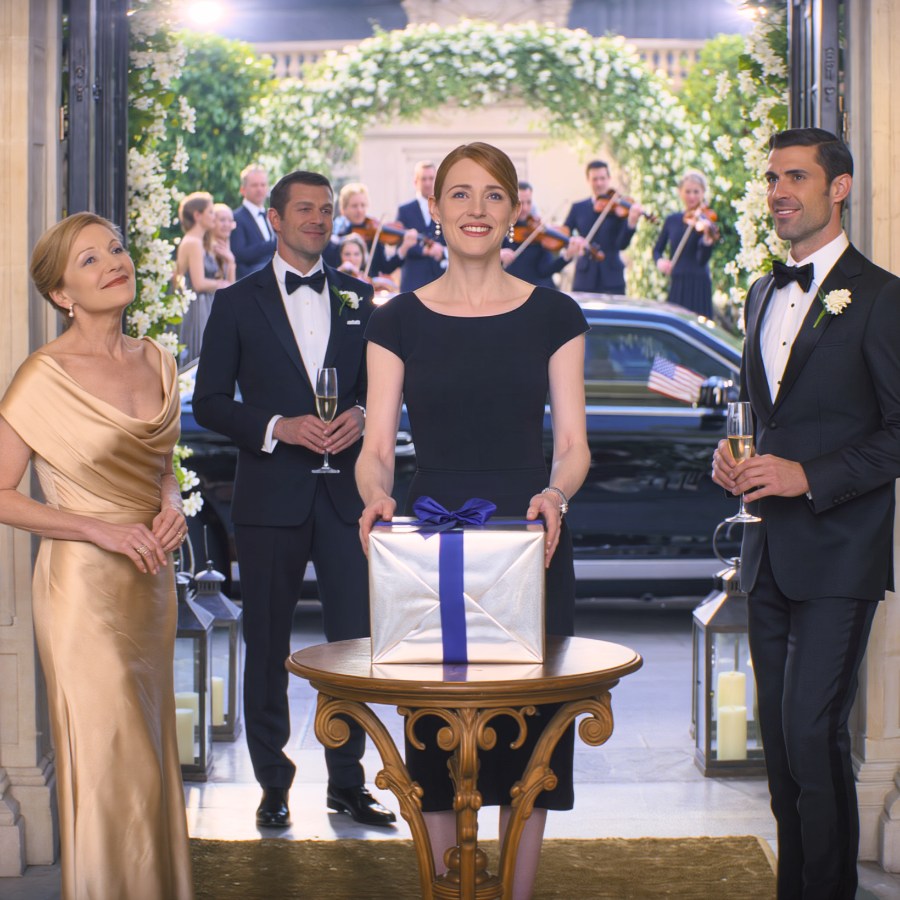
The first thing the wedding hostess noticed was the box.
It was a silver gift box with a navy ribbon tied in a precise cross and a bow that sat perfectly flat against the lid, the sort of wrapping that made people assume there was something tasteful and expensive inside. She looked at the box before she looked at me, which was not unreasonable. It was a wedding in late May, the kind of warm Chicago evening where everything about the venue had been arranged to appear effortless and cost a fortune.

There were white flowers climbing the entry arch, candle lanterns set in deliberate clusters along the stone path, a quartet playing somewhere deeper inside the property, and a row of black sedans and town cars pulling up in patient, gleaming intervals. Everyone arriving wore the expression people wear when they have somewhere important to be seen. The hostess had probably been staring at names, boxes, monograms, and social calculations for the better part of an hour.
Then she looked at me.
I was standing just beyond the threshold in a black midi dress I had bought three weeks earlier specifically for this night, because until that moment I had still believed there were some humiliations I would be spared if I prepared carefully enough. The dress had a fitted waist, a modest neckline, and sleeves that skimmed the elbows. It was elegant without trying too hard. I wore pearl earrings, my good heels, and the wedding band I had not yet taken off. I had driven forty minutes in holiday traffic to get there, had parked where I was told to park, had checked my lipstick once in the rearview mirror and then again because I know what it means to arrive among people who are always looking for a reason to tell themselves you do not belong.
The hostess gave me a polite smile and glanced down at the clipboard in her hands.
“Good evening,” she said. “Name?”
“Mara Reyes,” I said. “It may be under Mercer or Reyes. Mara Reyes.”
Her finger moved down the list once, then a second time, slower. She tilted the board slightly, as though the angle might reveal what the lines themselves would not. When she looked up again, the smile was still there, but now it had the cautious edges of professional bad news.
“I’m sorry,” she said. “I don’t see you on the list.”
There are people who react to embarrassment with motion. They laugh too loudly or talk too quickly or fill the silence with frantic explanation. I have never been one of those people. My instinct, when something shifts under me, is to become still and study it. So I stood there with the silver box balanced evenly in both hands and said, very calmly, “Could you check again?”
She glanced down. “Of course.”
“It might be under my married name,” I said. “Reyes. Mara Reyes.”
She was checking when Vivian appeared.
My mother-in-law had a gift for materializing at moments of maximum discomfort, as though she had spent her life developing an internal instrument tuned to the frequency of other people’s vulnerability. One moment the entrance was merely awkward. The next, there she was, emerging from the warm gold light of the venue interior in a silk gown the color of pale champagne, diamonds at her throat, her hair sculpted into place, a drink in one hand, already wearing the look of a woman who has found an opportunity and intends to enjoy it.
She took in the scene instantly: the hostess, the clipboard, me at the threshold with my gift box and my careful dress and my good heels. Then she smiled.
It was not a pleasant smile. It was something sharper than that, something that conveyed amusement, contempt, and relief all at once, as though she had been waiting for the universe to deliver me into exactly this position and was grateful not to have to engineer it herself.
“Did you actually think you were invited?” she asked.
She did not lower her voice. That was the point. Two bridesmaids standing several feet behind her heard every word, and because Vivian gave them permission to do so, they exchanged a quick smirk. I smelled juniper when she leaned closer, and beneath it the powdery, expensive perfume she wore in the evenings when she intended to be noticed.
“How pathetic,” she said softly enough for it to feel personal, loudly enough for it not to stay that way.
The hostess’s eyes widened, then shifted instinctively to me and away again. She was not malicious. She was just a woman being paid to stand at an entry table, suddenly caught between class warfare and family cruelty in formalwear.
I turned my head and looked for Ethan.
He was exactly where he should not have been: six feet away, near the welcome sign and escort cards, holding a champagne flute, tie already loosened slightly at the collar, talking to one of his college friends. He had seen all of it. Not part of it. All of it. He had seen the hostess fail to find my name. He had seen his mother walk over with that expression. He had seen her lean into my face and say the word pathetic. He had watched and had done nothing.
There are versions of a man. The version you marry. The version he becomes in his own family. The version he becomes when he believes there will be no consequences. Ethan, around his family, always expanded. His voice got louder. His laugh got rougher. His entitlement became visible, like something inflating beneath the skin. When he was alone with me, he could be careful and charming and attentive in a way that was convincing enough to build a life around. Around Vivian and Caroline and the old family friends and the people who remembered him at sixteen, he became someone older and uglier than his age, as though lineage itself licensed him to stop pretending.
He looked at me, then at the hostess, then at the open bar beyond her shoulder.
“She’s just the driver,” he said pleasantly. “She’s dropping off a gift.”
There are moments when a sentence changes the atmospheric pressure in a room. I could feel people nearby turn toward us before I actually saw them do it. The hostess blinked. The bridesmaids stopped pretending not to listen. Three older guests near the entrance looked over with discreet but unmistakable curiosity, the social instinct to locate drama drawing their attention with the efficiency of gravity.
She’s just the driver.
The remarkable thing about the moment was not that it hurt. Hurt would have been simpler. I had eight years of preparation for hurt. I had built a tolerance for it, callus over callus, dinner after dinner and slight after slight, the accumulated abrasion of being tolerated rather than welcomed, used rather than cherished, diminished so gradually that entire years had passed before I understood how much of me had been sanded down.
No, what happened inside me then was stranger and much colder.
Everything went still.
Not numb. Not blank. Still. Like a lake that has stopped showing you its surface because something beneath it has settled into place. I became conscious, in a single clear second, of the weight of the box in my hands, of the pressure of my right heel against the stone, of the pulse in my throat slowing rather than quickening. I understood, with a clarity so complete it felt almost merciful, that I was done.
I smiled.
Not sadly. Not bravely. Not the brittle smile of a woman trying to survive a humiliation in public. It was a small, composed smile that did not ask for anything and did not reveal anything.
“Of course,” I said.
Then I set the silver box on the entry table with both hands, very carefully, between the seating chart and the floral arrangement.
“Please make sure they get this,” I said.
I did not look at Vivian. I did not look at Ethan again. I turned, crossed the threshold, walked down the stone path, and continued across the parking lot toward my car in the heels I had chosen because I thought this occasion mattered. My pace never changed. I did not hurry. I did not cry. The night air had cooled slightly after sunset, and the sound of the quartet faded behind me as if someone had closed a door between one life and another.
I got in the car, placed my hands on the steering wheel, and sat there for one long breath.
Then I started the engine, drove out of the lot, took the first right, then another, and pulled over two blocks away beneath a live oak tree on a quiet residential street. Through breaks in the branches, I could still see the venue lights in the distance, warm and golden and absurdly serene.
I cut the engine.
The phone was on the passenger seat beside me.
I checked the time. 8:31 p.m.
Then I waited.
My name is Mara Reyes. I was thirty-four years old that spring, and for eleven years I had worked in financial forensics. The short explanation, the one I gave at parties when I had no desire to spend twenty minutes educating strangers, was that I followed money. The accurate explanation was more technical and much less charming. I specialized in discrepancy analysis, illicit fund routing, beneficial ownership exposure, and evidentiary reconstruction in complex fraud matters. My job was to identify patterns that should not exist, absences that had been manufactured to look natural, transactions that wore the clean clothing of legitimacy while carrying blood in their seams.
People imagine fraud as dramatic, but most of it is administrative. It lives in decimals. It lives in timing. It lives in the confidence that no one will look long enough or hard enough to notice that something small is wrong everywhere. The people who succeed at it are rarely sloppy. They are patient. They rely on routine. They rely on hierarchy. Most of all, they rely on the assumption that those doing the necessary work around them are too tired, too trusting, or too dependent to connect the dots.
I had spent most of my career connecting dots.
I am very, very good at my job.
The first time I met Ethan Mercer, he was standing near a donor display at a literacy nonprofit fundraiser wearing a navy suit that fit him too well for someone still in graduate school. He was twenty-seven, finishing his MBA, and had the particular kind of confidence men develop when they have always been told that their future is not only bright but inevitable. He was funny in an unforced way. He listened when I spoke. He asked questions that suggested both intelligence and interest, which are not the same thing and which, at twenty-five, I was still hopeful enough to mistake for each other.
I was there because I had volunteered with the organization since college. I came from a family where reading was a refuge and a ladder and a form of prayer. My father had repaired elevators for thirty-two years. My mother had taught second grade until her knees and back made the classroom impossible. We did not have money in the way Ethan’s family had money. We had solidity. We had schedules and paid bills and practical gifts at Christmas and the belief that if you worked hard, were decent, and knew how to endure boredom without complaint, life would usually meet you halfway.
Continue reading by clicking the button (Continue Reading »») below!