
He looked down at the document again.
“From discovery to today?”
“Yes.”
He was quiet for a moment.
Then he said, “Ms. Reyes, once this opens, timeline and outcome are not yours to control. The case goes where the evidence goes.”
“I understand.”
He studied me for a second longer, perhaps checking whether I understood emotionally or only procedurally. Then he nodded.
“We’re going to need corroboration independent of your work product,” he said. “You know that.”
“Yes.”
“And you should know whistleblower protections apply in certain contexts here, but not to every personal consequence that may follow.”
“I have separate counsel for that.”
This seemed to satisfy him.
My attorney was Patricia Okafor, a financial litigator and former federal prosecutor who had built a reputation on calm devastation. I had retained her two weeks earlier. On our first meeting she read my summary packet, leaned back in her chair, and said, “You’ve done ninety percent of the painful part. Now we make it expensive for them.”
There are people whose competence soothes you not because they are warm but because they are exact. Patricia was exact. I trusted her immediately.
After I left the federal building, I went home and made dinner as if nothing had changed. Ethan came in at 7:12, complained lightly about a client call, kissed my cheek, and asked whether we still had that bottle of Barolo from Christmas. I remember looking at him as he opened the wine and thinking how astonishingly much of his life depended on the assumption that I would continue behaving like background support.
I smiled. I set the table. I waited.
Waiting, it turns out, is one of my talents.
The six weeks between the handoff and the wedding were the strangest of my life. I knew a storm was building, but not where the first lightning would strike. Agent Parrish called twice from blocked numbers to verify details. Once about a routing sequence attached to a Texas acquisition. Once about the timing of a Delaware foundation transfer. On the second call he said, in the careful language of someone trained not to say more than necessary, that the Bureau was actively developing the matter.
I understood exactly what that meant. They were building their own case around mine.
At the same time, Patricia filed for divorce.
Quietly. No confrontation. No dramatic kitchen-table reveal. No chance for Ethan to shift assets if he was monitoring for impact. The petition was filed on a Thursday under seal where appropriate. Service would occur after the wedding, on Monday. Patricia chose the date strategically. By then, based on what she was hearing through legal channels, the criminal matter would be moving in a way that dramatically reduced Ethan’s room to maneuver.
In those same weeks, I built the gift.
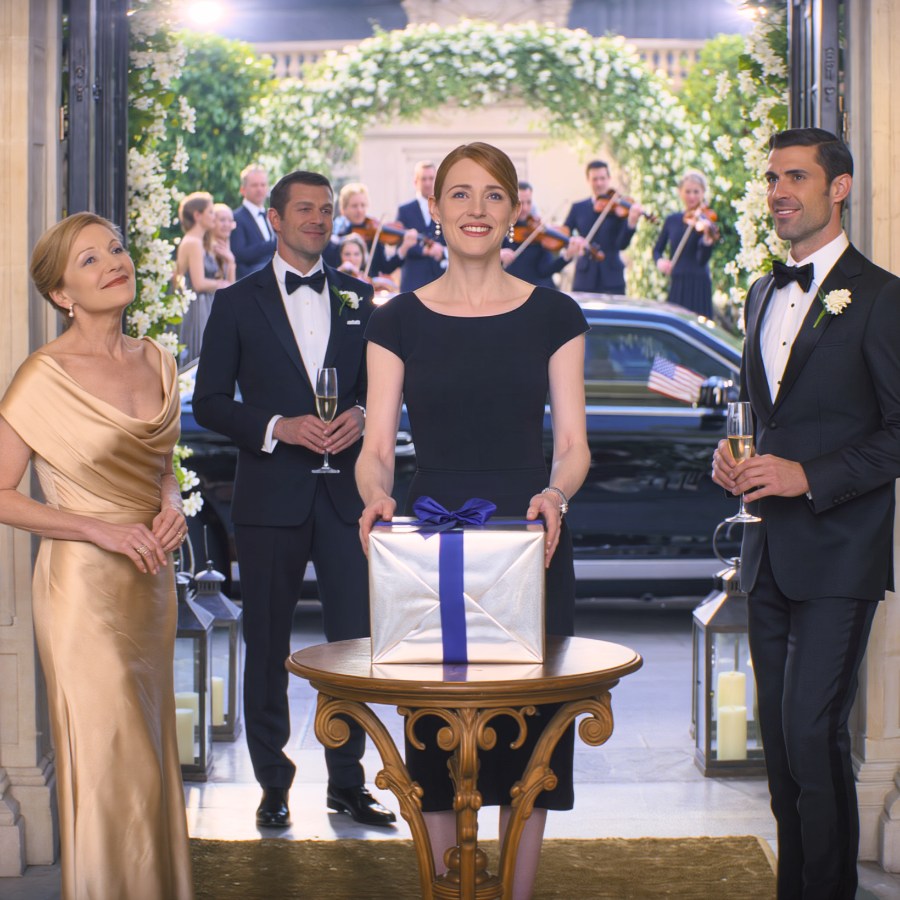
The box itself I ordered from a specialty stationer that catered to luxury events. Silver, rigid, twelve by sixteen inches, deep enough to hold a substantial printed packet without bowing. I wrapped it myself in navy ribbon because I wrap beautifully when I care enough to be precise. Inside, I placed a full duplicate of the dossier in the same tabbed order as the original: transaction map, entity structure, communications, wedding vendor trail, my financial records. Beneath the last tab I secured a small Bluetooth speaker, no larger than a hockey puck, linked to a burner phone programmed to auto-answer on first ring and broadcast at full volume.
I tested it twice.
The first time in my home office at midnight, speaking a draft of the statement into the phone and listening for clarity. The second time in the garage with the car door closed, timing how long it took from answer to first spoken sentence. I adjusted the sequence. Precision matters. In financial crime. In evidence. In theater.
Because yes, there was theater in what I planned. Not because I wanted spectacle for its own sake. Because people like Vivian survive on the assumption that shame belongs to other people. They weaponize public humiliation while insulating themselves from it. They understand optics when optics favor them. I wanted, very deliberately, to break that symmetry.
I also had one practical advantage none of them knew I still possessed. Eight months earlier, before Vivian had decided I was “not the right fit” for the wedding planning committee, I had built the master timeline spreadsheet for the event. I did it because Caroline was disorganized, because Ethan asked me to help, and because I am pathologically incapable of designing logistics badly. Vivian later edged me out once the glamorous decisions began, but not before I had created the infrastructure. A copy of the spreadsheet still sat in my Google Drive. I knew the sequence of the night down to the quarter hour.
At 8:45 p.m., according to the timeline I had built, the best man would present family gifts at the head table before the final round of toasts.
I knew when the box would be opened.
And then came the entrance. The hostess. Vivian’s smile. Ethan saying, She’s just the driver.
Sitting under the live oak tree two blocks away, I checked the time again. 8:38.
My hands rested on my knees. They were perfectly steady.
I remember noticing the steadiness because it surprised me. I had spent years imagining what revenge, if it ever came, might feel like. Heat, perhaps. Fury. Vindication so strong it tasted metallic. What I felt instead was concentration. Clean, narrow, and absolute.
8:42.
A car passed slowly down the street and continued on. In the distance I could hear music drifting faintly from the venue grounds when the wind shifted. Somewhere nearby a sprinkler clicked across a lawn. The branches overhead moved against the light.
8:44.
I picked up the burner phone.
8:45.
I dialed.
Later, much later, through public filings, witness statements, and one surreal conversation with Gerald Whitmore, I reconstructed the scene inside the tent.
Marcus Hale, the best man and one of Ethan’s college friends, had taken the silver box from the entry table when a staff member brought it over. He carried it to the head table with the easy confidence of a man assuming it contained crystal, silver, or perhaps a sentimental family item from a relative unable to attend. Caroline was still in her dress, her veil long gone, makeup slightly softened by the evening, radiant in that exhausted bridal way that makes women look both queenly and very young. Ethan was seated nearby, one hand around a whiskey glass.
He saw the navy ribbon and, according to Marcus’s later statement, said, “Probably something sad from Mara.”
Probably something sad from Mara.
There is a kind of contempt so habitual it becomes casual language. That sentence was casual language.
Marcus lifted the lid.
The burner phone rang.
That alone drew attention. Sound where there should have been silence always does. Marcus, amused, reached in and picked it up. The device auto-answered. The speaker engaged.
His voice came through first, because he said hello in the baffled half-laughing tone of someone expecting a prank.
Then mine replaced it.
I had practiced the words once, late at night, standing in front of my bathroom mirror in pajamas, speaking in the same steady register I used in deposition rooms and courtrooms. In the car beneath the live oak, I did not need the script. It was fully memorized.
“I hope everyone is enjoying the two hundred and fifty thousand dollar wedding,” I said.
I did not raise my voice. You do not need volume when truth enters a room already amplified by its own weight.
“Especially the partners from Ethan’s firm. Every flower, every bottle of champagne, every stitch of the bride’s dress was paid for with stolen client funds.”
According to three separate witness statements, the tent went silent so completely that the next sound anyone remembered was the clink of one fork hitting one plate.
“I know about the Peterson Acquisition escrow,” I said. “I know about the Cayman foundation routing. I know about Mercer Event Solutions.”
At the head table, Gerald Whitmore—the senior managing director from the firm, a man with twenty-six years of institutional memory and an instinct for danger—set down his glass and leaned forward. Across the room, Vivian rose so quickly her chair tipped backward.
She understood immediately.
That, to me, remains one of the most revealing details. Innocent people are confused by accusation. Guilty people are fast.
Marcus said later that Vivian crossed the tent in seconds, weaving between tables with startling speed for a woman in heels and silk, her face transformed by something far more naked than anger. Not outrage. Fear. Raw and unmasked.
She reached the box and began ripping through the contents.
Not searching, exactly. Tearing. Tabs flew. Paper spilled. Three hundred and twelve pages of transactions, shell registries, email excerpts, vendor trails, all of it scattering across linen and candlelight and polished wood. She was looking for the speaker, for the point of control, for the thing she could silence. But by then the sentence that mattered was already in the room and could not be removed with the hardware.
Then came the line I had built the entire mechanism around.
“You called me the driver tonight, Ethan,” I said. “You were wrong. I’m the whistleblower.”
I ended the call.
For three seconds there was, by every account, no sound at all.
Then the front of the venue erupted in red and blue light.
Four black SUVs. Three police cruisers. Fifteen federal agents in windbreakers moving with the kind of organized, impersonal efficiency that no amount of flowers can make less terrifying. Agent Parrish led the team. He had chosen the night deliberately. That much I learned later and admired professionally, whatever else one might say about timing an arrest to a wedding reception. The senior partners from the firm were present. Key witnesses were present. The fraud-funded expenditures were physically present. The optics were impeccable.
The agents moved through the tent as the musicians stopped mid-phrase.
Guests stood. Some backed away. Some stayed frozen. Some, because human beings are strange, instinctively reached for their phones before staff began telling them not to record.
Vivian was handcuffed near the head table in front of people whose respect she had spent thirty years cultivating through committees, donations, lunches, and glossy displays of elegance. The diamonds were still at her throat. A witness later described her as screaming. More than one used that exact word. She screamed about misunderstanding, about lawyers, about humiliation, about this being absurd. She screamed Ethan’s name. She screamed Caroline’s. She screamed mine.
Ethan did not scream.
He went to his knees.
That detail reached me in fragments first, then in full confirmation later, and it stayed with me more stubbornly than I expected. Not because it gave me pleasure. Because it was revealing. There are collapses that happen slowly in private and collapses that happen all at once in public when fiction can no longer bear the weight placed on it. Ethan had been standing on a platform made partly of money, partly of family mythology, partly of my labor. In one night, all three supports failed at once.
Caroline stood in her dress among the falling pages and watched her wedding become an evidence scene.
And I, two blocks away under a live oak tree, watched the flicker of emergency lights through the branches.
I did not laugh.
I did not cheer.
I did not cry.
What I felt, if I am honest, was not triumph but release. Not joy. Not vengeance. Release. A pressure I had been carrying for so long I had stopped distinguishing it from my own spine finally lifted. My body recognized the difference before my mind did.
I put the car in drive and went home.
That sentence matters: I went home.
Not to the venue. Not to watch. Not to claim any emotional front-row seat to the destruction. Home. Because the event itself, the arrest and the lights and the public shock, was only the visible ending of a much longer invisible process. The real change had happened before. It happened when I stopped believing that usefulness was love. It happened when I stopped confusing endurance with virtue. It happened when I looked at evidence and finally applied the same rigor to my marriage that I had always applied to numbers.
The next morning Patricia called before 8:00.
“They moved,” she said.
“I know.”
“Good. Ethan and Vivian were both taken in. There will be indictments. Likely a broader cooperation push. Do not respond to any communication directly. Forward everything to me.”
I made coffee. I opened my laptop. I had twelve unread emails from work and one from a colleague asking if I could review an anomalous ledger on a real estate fund matter by afternoon. I replied yes.
That, too, may sound cold. It was not cold. It was anchoring. Work had always been one of the few places where truth mattered more than performance. Numbers did not care who sat at the head of the table. They either reconciled or they did not.
The indictments were unsealed within days.
Continue reading by clicking the button (Continue Reading »») below!