
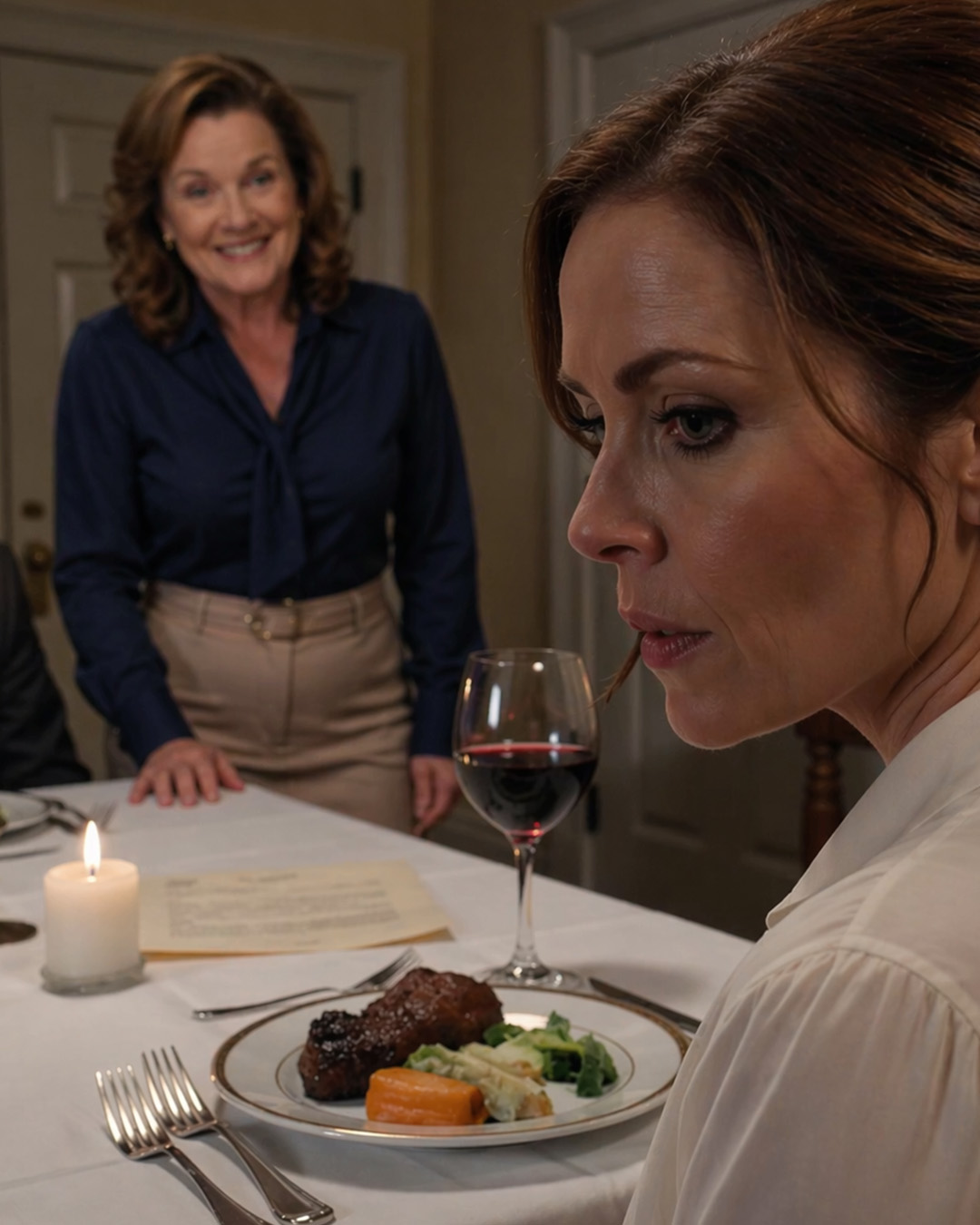
Toen haalde ik langzaam een document uit mijn tas en schoof het over de tafel. Ze las het één keer, en toen nog een keer.
“Dit kun je niet doen!”
Mijn naam is Ingred Holloway. Ik ben 37 jaar oud. Afgelopen oktober zat ik aan de eettafel van mijn moeder, terwijl ze me glimlachend aankeek en zei: “Dit is je laatste maaltijd in dit huis.”
Ze bedoelde het als een dreiging. De hele familie was bij elkaar, mijn tante, mijn nicht, haar vriend, en ze zag er zo zelfverzekerd uit, zo volledig in controle, dat ik bijna medelijden kreeg met wat ik op het punt stond te doen. Bijna.
Ik haalde langzaam een document uit mijn tas en schoof het over de tafel.
‘Die van jou ook,’ zei ik.
Mijn moeder las het één keer, en toen las ze het nog een keer. Haar gezicht veranderde van roze naar wit, alsof er een stekker uit het stopcontact was getrokken.
‘Dit kun je niet doen,’ fluisterde ze.
Maar ik kon het wel, en zij wist het.
Voordat ik je vertel hoe ik tegenover mijn eigen moeder aan tafel terechtkwam, wil ik je vragen even te liken en je te abonneren, en je locatie en lokale tijd in de reacties te vermelden. Ik vind het leuk om te weten waar jullie allemaal vandaan luisteren.
Laat me u nu even meenemen naar 20 jaar geleden, naar een huis aan Riddle Creek Road en de nacht dat mijn grootvader stierf. Het huis stond aan het einde van Riddle Creek Road in Garner, North Carolina. Een gelijkvloers huis met een grijs pannendak en een veranda die zich als een arm om de voorkant heen slingerde en je naar binnen trok.
Mijn grootvader, Earl Puit, bouwde het zelf in 1978. Hij legde elke plank, hing elke deur op en groef de put voordat de gemeente waterleidingen zo ver aanlegde.
Opa Earl was timmerman van beroep en een rustige man uit vrije wil. Hij praatte niet veel tijdens familiebijeenkomsten, maar op zaterdagmorgen gaf hij me een schuurblok en liet me naast hem werken. Ik was de enige met wie hij dat deed.
Ik was vijftien toen hij me op die veranda liet zitten en iets zei wat ik toen niet begreep.
“Dit huis is niet van hout en spijkers gemaakt. Birdie, het is een belofte.”
Birdie, zo noemde hij me. Niemand anders deed dat ooit.
Hij overleed twee jaar later. Een zware beroerte, midden in de nacht. Ik was 17.
Mijn moeder kreeg het telefoontje om 6 uur ‘s ochtends, legde de hoorn neer en zei: “Nou, het is klaar.” Geen tranen, geen trillende kin, alleen die drie woorden, vlak als een aanrechtblad.
Ik herinner me dat ik de dag na de begrafenis in zijn lege werkplaats stond en met mijn hand over de werkbank streek die hij in de loop der decennia zo glad had geschuurd. Zijn koffiemok stond er nog, met een ring van opgedroogd zwart op de bodem. De hele ruimte rook naar zaagsel en lijnolie.
Ik heb een uur lang gehuild in die werkplaats. Toen ik weer binnenkwam, was mijn moeder al aan de telefoon met iemand, ze sprak zachtjes en stond met haar rug naar me toe. Ze hing op toen ze me zag.
Ik dacht er toen niets van. Ik was 17 en mijn grootvader was overleden.
En ik wist toen nog niet dat wat ze me had afgenomen al begonnen was. Een maand na de begrafenis riep mijn moeder me de keuken in. Ze stond bij het aanrecht met een mok koffie die ze niet dronk, haar armen strak over elkaar geslagen.
Ik kon zien dat ze iets aan het repeteren was geweest.
‘Je grootvader heeft geen testament achtergelaten,’ zei ze. ‘Er is niets, alleen dit huis vol schulden.’
Ik vroeg of er een advocaat bij betrokken was, iemand met wie we moesten praten. Ze wuifde met haar hand alsof ik iets belachelijks had voorgesteld.
“Er was geen advocaat. Hij stierf zoals hij geleefd had. Geen plan, geen voorbereiding. Ik ben degene die er nu mee moet dealen.”
Ik was 17. Ik geloofde haar.
Die lente werd ik toegelaten tot een rechtenstudie aan NC State. Ik had er twee jaar naartoe gewerkt. Oefenrechtspraak, AP-staatsinrichting, een aanbevelingsbrief van mijn docent maatschappijleer die ik nog steeds ergens in een la heb liggen.
Mijn moeder liet me er diezelfde week nog bij zitten toen de acceptatiebrief binnenkwam.
‘Denk je dat je zomaar naar de universiteit kunt gaan terwijl ik hier verdrink?’ zei ze. ‘Alleen al de hypotheek op dit huis? Wie gaat me helpen? Wie gaat de elektriciteit betalen?’
Er was geen hypotheek. Het huis was volledig afbetaald. Earl Puit geloofde niet in schulden bij banken.
Maar dat wist ik niet.
‘Na alles wat ik voor dit gezin heb gedaan,’ zei ze, ‘willen jullie me hier alleen achterlaten? Dat is de dank die ik krijg.’
I withdrew my application the next day, took a job as a cashier at a hardware store off Route 70, gave my mother $300 a month from my first paycheck and every paycheck after. I didn’t know she was lying. I just knew I couldn’t be the daughter who walked away.
That was the first surrender. It wasn’t the last.
The years blurred together the way they do when you’re stuck in a pattern you can’t name. At 19, I moved back home. Just temporarily.
My mother said, “I need help with the gutters and the plumbing. You know I can’t do that alone.”
I paid for the repairs. Temporarily turned into three years.
At 23, I told her I was looking at apartments in Raleigh. She set her fork down at dinner and said, “You’d really leave your mother in this big house alone?”
I stayed another year.
At 27, I landed a better position at an office supply company. Decent salary, benefits, room to grow. My mother didn’t say, “Congratulations.”
She said, “Does that mean you’ll send more?”
At 30, I enrolled in an online paralegal certificate program. I did the coursework at night after my shifts. My mother found the textbooks on my nightstand and said, “Still chasing that lawyer dream? Some people just aren’t cut out for it, Ingred.”
I finished the certificate anyway. That was the first thing I did in 16 years that she didn’t talk me out of.
At 31, I finally moved to Raleigh, rented a one-bedroom apartment near Capital Boulevard. My mother called it the betrayal. She used that word, betrayal, like I’d committed a crime.
Even after I left, I sent her $400 a month. She said it was for the mortgage. There was no mortgage.
She said it was for upkeep. The house my grandfather built with his hands didn’t need $400 a month in upkeep.
But I sent it because every time I thought about stopping, I heard her voice. After everything I’ve done for you, every dollar I sent was a brick in a wall she was building around me.
Fourteen months before the dinner, my mother met Ray Beckett at church. She called me on a Tuesday to tell me about him.
“He’s a good man,” she said with a brightness in her voice I hadn’t heard in years. “A plumber, works for himself, solid.”
By the third month, Ray had moved in. By the sixth, he was tearing off the old roof and replacing it with architectural shingles. New deck by month nine. Fresh paint inside and out by month 12.
My mother sent me pictures like she was flipping through a home renovation magazine.
“Ray’s really investing in our future,” she said.
I asked, “Your future or the house’s future?”
She hung up on me.
The first time I met Ray, he shook my hand too hard and held it too long.
“Your mama’s told me all about you,” he said. “She’s done a lot for you, honey. I hope you appreciate that.”
He said it the way you’d talk to a teenager who forgot to take out the trash. I was 36 years old.
Over the next few visits, a picture formed. Ray walked through that house like a man measuring walls for furniture he hadn’t bought yet. He talked about the property and the lot and what the market was doing in Wake County.
At Thanksgiving, he told my aunt Vivien that Garner was about to pop and that sitting on paid-off real estate was the smartest thing a person could do. My mother smiled the whole time. Ray put his arm around her and squeezed.
That Christmas, she mentioned it for the first time, casually, like it was nothing.
“Ray and I have been talking about making things official. The house, I mean.”
I didn’t respond, but I heard it.
The phone call came on a Tuesday evening in early October.
“Sunday dinner,” my mother said. “The whole family. I have an announcement.”
Her voice had that particular brightness, the one she used when she’d already made a decision and wanted an audience to witness it. I recognized the tone the way a dog recognizes a leash.
“What kind of announcement?” I asked.
She laughed.
“You’ll find out with everyone else.” Then, sharper: “And don’t bring that attitude. This is a happy occasion.”
I called my aunt Vivien that night. She didn’t know any specifics, but she’d picked up the same signal.
“Your mother sounded like she was planning something big,” Vivien said. “She keeps saying Ray needs security, that a man needs to feel like he belongs somewhere.”
I sat on my couch in my Raleigh apartment and stared at the ceiling. The math wasn’t hard.
Gloria plus Ray plus announcement plus the whole family equaled one thing.
She was putting Ray’s name on the deed. She was giving away my grandfather’s house to a man she’d known for 14 months.
I didn’t sleep much that night. I lay in bed running through the same loop. Call her, confront her, ask her to wait. But I already knew how that conversation would go.
She’d tell me it was none of my business. She’d say I was being selfish. She’d remind me of everything she’d ever done for me. And I’d hang up feeling smaller than when I’d dialed.
Except this time, something was different. Something I’d learned at work, a skill I used every day for other people’s families, was quietly rearranging itself in my mind.
I didn’t know yet that my mother couldn’t give away what was never hers. But I was about to find out.
Wednesday morning, Morrison and Grant Estate Law, downtown Raleigh. I’d been working there as a paralegal for three years, filing motions, drafting correspondence, pulling records. The kind of work that makes you invisible to the lawyers and essential to the cases.
That morning, I was running a title search for a client. Routine. Pull up the Wake County Register of Deeds website, type in the property address, trace the chain of ownership.
I’d done it hundreds of times.
Halfway through, I stopped. My fingers hovered over the keyboard.
If my mother was planning to sign a quitclaim deed, that meant the property title had to be in her name, and titles were public record. Anyone could look them up. I could look them up.
I typed in the address on Riddle Creek Road. The result loaded in under three seconds.
The deed was recorded in 2005, the year my grandfather died. The grantor was the estate of Earl T. Puit.
The grantee line read: Gloria Holloway, trustee of the Earl Puit Testamentary Trust for the benefit of Ingred M. Holloway.
I read it three times. Each time the words got louder, not on the screen, in my chest.
Trustee. For the benefit of Ingred M. Holloway.
My grandfather had left me the house, not my mother. Me.
He’d put it in a trust, a legal trust, with my mother named as the person responsible for holding it until I was ready to receive it. And she had never said a word.
I closed the browser tab, opened it again, read it a fourth time. The words didn’t change.
I pushed back from my desk and walked to the break room, poured a cup of coffee I didn’t drink. My hands were steady. Everything else was shaking.
I didn’t need anyone to explain what a testamentary trust was. Three years of estate law had taught me that much. A testamentary trust is created through a will. The person who dies, the grantor, leaves property to a trustee who holds it for the benefit of someone else until certain conditions are met, usually an age, usually 21.
My grandfather set it up so that my mother would manage the house until I turned 21. Then she was legally required to transfer the title to me, full ownership, my name on the deed.
I was 37. She’d been in violation of her fiduciary duty for 16 years.
I pulled up the probate records next. The will had been filed with the Wake County Clerk of Superior Court in 2005. The trust had been established and funded. The property had been transferred into the trust.
Everything was documented, dated, and recorded.
My mother had walked into a courthouse, filed the paperwork, accepted the role of trustee, and then gone home and told her 17-year-old daughter that her grandfather left nothing.
I sat in my car after work that evening with the engine off. I didn’t cry. I didn’t scream. I just sat there with the kind of clarity that comes after something breaks clean.
She told me he left nothing. She said there was no lawyer.
She made me give up law school so I wouldn’t learn enough to find out.
It wasn’t random cruelty. It was a system.
Every choice she’d made, pulling me out of school, keeping me close, making me financially dependent, had one purpose: to make sure I never had the tools to ask the right questions.
My mother didn’t just take a house. She took the education that would have let me find out sooner.
I picked up my phone that night and dialed her number. Got through three rings before I stopped.
If I called now, she’d deny it. She’d twist the conversation until I was apologizing for asking. She’d cry or shout or go silent, whatever tool worked fastest, and by the end of the call, I’d feel guilty for finding out the truth.
That was the pattern. Twenty years of it, worn smooth as a path through grass.
I set the phone down. For the first time in my life, I chose not to react.
Instead, I made a list. I wrote it on the back of a gas station receipt because I didn’t have a notepad in my car.
Find the original trust instrument. Find the lawyer who drafted it, Harold Puit. Verify the exact trust terms. Understand my legal rights. Prepare everything before Sunday.
Sunday was four days away. Four days to confirm what 20 years had hidden.
The next morning at the office, I told Marin Torres. She was the other paralegal at Morrison and Grant. Thirty-four, direct, loyal in a way that didn’t require a lot of words.
We’d worked side by side for two years. She was the closest thing I had to a best friend.
I showed her the deed printout. She read it twice, then looked at me over her glasses.
“You’ve been her paralegal your whole life, Ingred,” she said. “Time to be your own.”
I asked if she thought I was wrong for not calling my mother first.
“She kept you from law school so you’d never read the fine print,” Marin said. “That tells you everything.”
She was right. And Sunday was coming.
Thursday, I spent my lunch break searching the North Carolina State Bar records. Harold Puit, licensed 1974, retired 2009. Last known address, Garner, North Carolina.
He was still alive. Still local.
I found his number through a public directory and called from my car in the Morrison and Grant parking lot. It rang five times. I was about to hang up when a slow, careful voice answered.
“Puit residence.”
I told him my name. There was a long silence, the kind where you can hear someone adjusting to a memory they hadn’t touched in years.
“Birdie,” he said. “Earl’s Birdie.”
Something cracked open in my chest when he said that name. Nobody had called me Birdie in 20 years.
I told him what I’d found. The deed, the trust, the fact that my mother had never transferred the house.
Harold went quiet again, but this time it was a different kind of quiet, heavier.
“She never gave you the house?” he said. It wasn’t a question.
Continue reading by clicking the button (Continue Reading »») below!