
“No, sir.”
He told me he’d drafted everything himself, the will, the trust instrument, the whole estate plan. Earl had come to his office in the spring of 2005, six months before the stroke, and laid it all out.
“The house goes to Ingred. Gloria manages it until the girl turns 21. Then it’s hers, free and clear.”
After the trust was set up, I called Gloria to remind her of her obligations, Harold said.
“She told me, ‘I know what I’m doing, Mr. Puit.’ I didn’t follow up after that.”
He paused.
“Your grandfather asked me to watch over things, and I didn’t. I’m sorry for that, Ingred.”
Those were his exact words, and they meant more than he knew.
Friday morning, I took a half day and drove to Garner. Harold Puit lived in a brick ranch house on a street lined with crepe myrtles that had already dropped their blooms.
He met me at the door in a pressed shirt and suspenders, moving slowly but standing straight. He looked like a man who’d been waiting for someone to come asking.
His office was a converted bedroom at the back of the house, shelves of legal binders, a wooden filing cabinet, a desk lamp with a green glass shade. He opened the bottom drawer of the cabinet and pulled out a cardboard filing box labeled Puit, Earl T.
Inside: a copy of my grandfather’s will, the trust instrument, the probate records, a letter of instruction.
I opened the trust instrument first. The language was clean, formal, and unmistakable.
Upon the beneficiary reaching the age of 21, the trustee shall convey all right, title, and interest in the property to the beneficiary by executing and recording an appropriate deed.
My name was on the third line. My grandfather’s signature was at the bottom of the last page. Steady, deliberate, like everything he built.
Harold walked me through it. Because Gloria never executed the transfer when I turned 21, she was in breach of her fiduciary duty. She had no legal right to treat the property as her own, and any quitclaim deed she signed to transfer interest to Ray Beckett would be void because she wasn’t the owner.
She was the trustee.
“When is she planning to sign that deed?” Harold asked.
“Sunday,” I said.
He took off his glasses and cleaned them with his handkerchief.
“Then we’d better get to work.”
He offered to prepare an affidavit, a sworn statement confirming the trust’s authenticity and his role in drafting it. I accepted.
While we worked, Harold mentioned something I hadn’t known.
“Your grandfather didn’t just leave you the house,” he said. “There was also a savings account, $38,000, held in the trust.”
I set down the paper I was holding.
“Gloria was custodian of the funds,” he continued. “Same terms. To be distributed to you at 21.”
I knew before I checked. I already knew. But I checked anyway.
That evening, I called the bank listed in the trust documents, a regional branch in Garner. The trust account had been closed in 2008. The full balance withdrawn by the trustee.
I was 20 years old, one year before the funds were supposed to be mine.
I sat at my kitchen table and did the math on the back of an envelope. $38,000 from the trust account, gone, plus $400 a month I’d sent my mother for the past 10 years. $48,000 total.
She had taken my inheritance and my paychecks.
I remembered 2008 clearly. That was the year my mother showed up to Thanksgiving in a new Buick LaCrosse. Metallic silver. Leather seats.
“I’ve been saving for years,” she told the family. “Finally treated myself.”
$38,000.
She turned my grandfather’s savings into a sedan and drove it to church every Sunday.
I didn’t throw anything. I didn’t call her screaming.
I opened a spreadsheet on my laptop, entered every figure I could document, and saved the file. Paralegal mode, the same focus I used for clients at Morrison and Grant.
Except this time, the client was me.
By midnight, I had a paper trail that stretched back 20 years. Bank records, deed history, trust terms, everything my mother had taken, itemized and timestamped.
Facts don’t need volume. They just need documentation.
Saturday, I drove out to Riddle Creek Road under the excuse of picking up some old clothes I’d left in the back closet.
The house was buzzing. My mother had the good china out, the set she only used for Easter and company. Fresh flowers on the dining table, candles.
Ray was outside hanging a new porch light, his tool belt slung low like a man who already lived here, which I supposed he did.
“Tomorrow is going to be special,” my mother said as I came through the kitchen. She was arranging linen napkins. Linen for a Sunday dinner.
“Ray and I have worked so hard on this house. It’s time to make it official.”
I kept my voice level.
“Official how?”
“I’m putting Ray’s name on the deed. He’s earned it.”
I looked at her. She was smiling the way she smiled when she’d already decided something and was simply waiting for the world to agree with her.
I tried one more time.
“Mom, don’t you think we should talk about this first? Just you and me?”
She barely glanced up from the napkins.
“There’s nothing to discuss. This is my house and I’ll do what I want with it.”
I nodded, collected my clothes from the closet, said goodbye to Ray, who told me to bring an appetite tomorrow. Then I walked to my car, sat behind the wheel, and breathed for 30 seconds.
She’d said it herself. This is my house. There’s nothing to discuss.
For once, I agreed with her. There was nothing left to discuss.
I drove straight to Harold Puit’s house. We had one more day, and we were going to use every hour of it.
Harold’s kitchen table became our war room. We spread everything out and organized it into a single folder: the certified copy of the deed from the Register of Deeds, showing the property held in trust for my benefit; the trust instrument with my grandfather’s signature; Harold’s affidavit, notarized that afternoon at the UPS Store on Timber Drive, confirming he’d drafted the trust at Earl Puit’s direction and had personally informed Gloria of her obligations as trustee.
And finally, a formal demand letter on Harold’s old firm letterhead requesting that Gloria comply with the trust terms and cease any unauthorized transfer of the property. Harold had kept his bar license on inactive status. The letter was clean, professional, and left no room for misinterpretation.
“You don’t need to raise your voice tomorrow, Ingred,” he said, placing the last page in the folder. “The paper does the talking.”
I called Marin that evening. Told her the plan.
“You sure about this?” she asked, not doubting, checking.
“She told me yesterday there’s nothing to discuss,” I said. “She said it’s her house.”
I paused.
“She chose to make it public. I’m just bringing the receipts.”
“I’ll have my phone on,” Marin said. “Call if you need backup.”
I packed everything into my bag, the brown leather satchel my grandfather gave me for my 16th birthday. The stitching was coming loose at one corner, and the brass buckle had gone dark with age, but the leather was soft and warm in my hands, and when I held it, I could almost smell the workshop. Sawdust and linseed oil.
I set it by the front door and went to bed. I didn’t sleep well, but I slept.
Tomorrow, the paper would talk.
Sunday morning. Gray sky, cool air, the kind of October day in North Carolina where the light comes through the trees at a slant and everything looks sharper than usual.
I stood in my apartment bathroom and looked at the bag sitting on the kitchen counter. The folder was inside. The trust, the deed, Harold’s affidavit, the demand letter, everything I needed, packed neatly inside a satchel that smelled like my grandfather’s workshop.
I thought about not going. I could call her, tell her I knew, give her a chance to handle it privately on her terms. Wasn’t that the kinder thing to do?
But I’d already tried that yesterday in her kitchen.
“Can we talk about this, just you and me?”
And she’d said no.
She’d said it was her house and there was nothing to discuss. She’d chosen the audience. She’d chosen the stage. And if I called now, if I gave her warning, the deed to Ray would be signed by sundown. She’d have a notary lined up before I hung up the phone.
I put on a white blouse and black slacks, the same thing I wore to work. No makeup. This wasn’t a celebration.
The drive from Raleigh to Garner was 40 minutes. I took Route 70, past the hardware store where I’d worked at 17, past the elementary school where my grandfather used to pick me up in his truck.
The road hadn’t changed. The houses looked smaller.
I pulled onto Riddle Creek Road at 4:15. Ray’s truck sat in the driveway. Aunt Vivien’s sedan was parked at the curb. My cousin Brin waved from the porch steps.
I picked up the bag. The leather was worn smooth at the handles.
Grandpa Earl would have approved.
The front door was propped open. I could hear my mother’s voice before I crossed the threshold. Bright, musical, the performance version of herself she used when she wanted something witnessed.
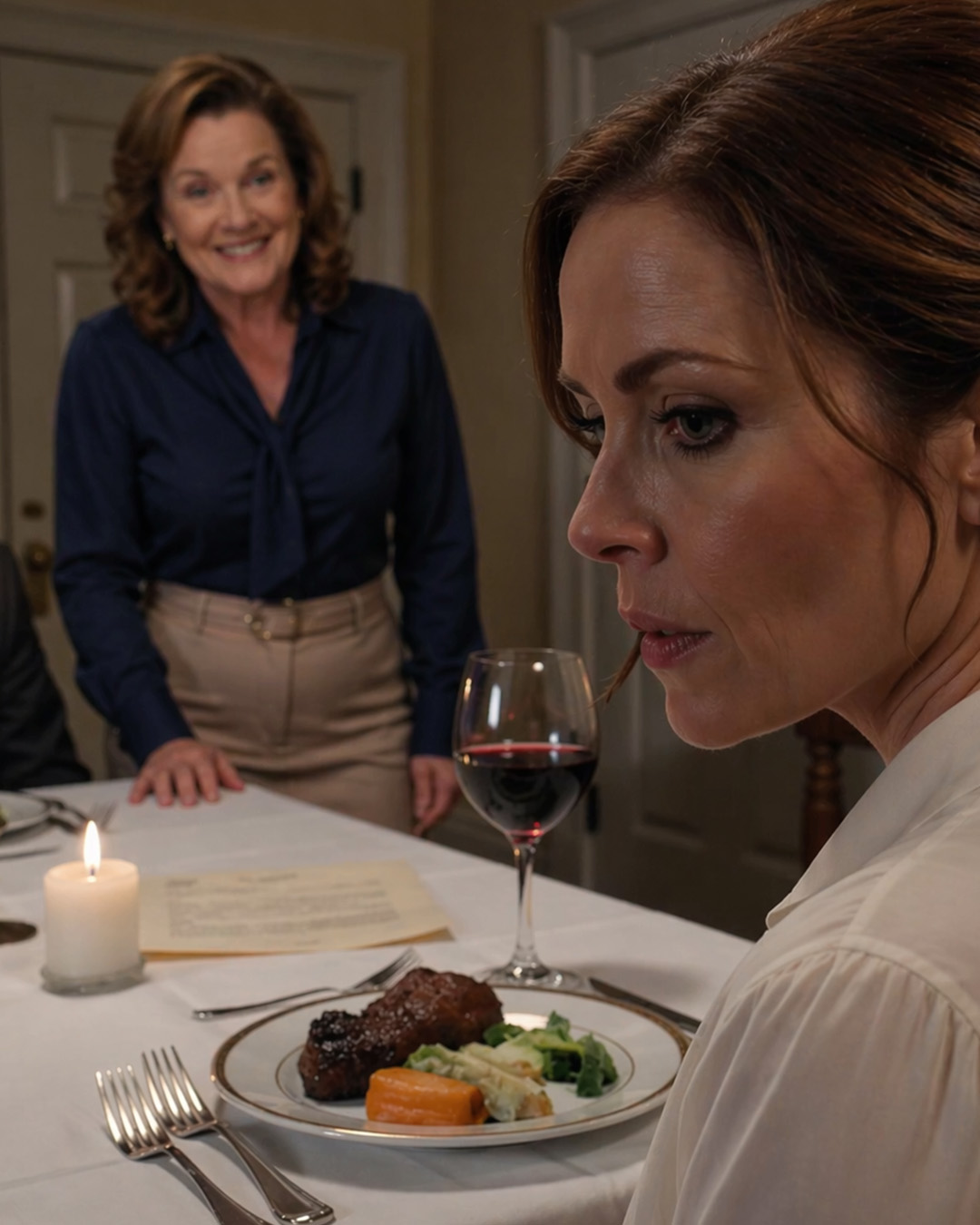
The dining room table was stretched to its full length. Eight chairs, white tablecloth, the good china as expected, candles lit, flowers in the center, and a roast so large it could have been an altar.
My mother came around the corner from the kitchen and wrapped me in a hug that smelled like hairspray and Chardonnay.
“There she is. Sit down, honey. Big night.”
Ray stood by the buffet, pouring wine into glasses he’d lined up like soldiers.
He shook my hand and said, “Good to see you, Ingred. Your mom has been cooking all day.”
Aunt Vivien sat on the couch in the living room, her hands folded in her lap, the way she held them when she was uncomfortable but hadn’t decided why. Uncle Dale was beside her, already working on a roll. My cousin Brin was setting water glasses on the table.
I noticed it immediately. On the kitchen counter near the flower arrangement, a clear plastic folder sat open.
Inside, a quitclaim deed form, pre-filled. My mother’s name in the grantor line. Ray Beckett’s name in the grantee line. A pen clipped to the edge.
She’d already filled it out.
I set my satchel on the floor beside my chair, close enough to reach.
Brin leaned in and whispered, “Aunt Gloria keeps talking about the surprise. Do you know what it is?”
I looked at the folder on the counter, then at my bag on the floor. Two sets of documents in the same room, pointed in opposite directions.
“I have a pretty good idea,” I said.
My mother waited until everyone was seated and served before she stood up. She picked up her wine glass and tapped it once with her nail, a small sharp sound that silenced the table.
Ray straightened beside her. This was rehearsed.
“I want to thank everyone for being here tonight,” she began. “This house has been my whole life. I raised my daughter here. I kept it standing when nobody else was going to.”
She paused. Let that land.
“Not a day went by that I didn’t put this family first.”
Aunt Vivien nodded politely. Uncle Dale chewed. Brin glanced at me.
“And for the last year,” my mother continued, “Ray has made this house feel like a home again.”
She reached for his hand. He took it, squeezed, smiled at the table like a man receiving an award.
“He’s fixed the roof, the deck, the plumbing. He’s poured his heart into this place.”
Another pause, longer this time.
“So tonight, I’m making it official.”
She looked around the table, letting the moment build.
“Ray and I are putting his name on the house. This is our home now.”
Ray reached behind him and produced the quitclaim deed from the counter. He set it on the table beside her plate. My mother picked up the pen and signed her name on the grantor line with a flourish.
No notary, no witness requirement met, just the gesture of it, the theater.
Then she slid the paper toward me. Not toward the table generally, toward me.
She looked straight into my eyes with a smile that was equal parts triumph and warning.
“I hope you’re happy for us,” she said.
I looked at the signed form. I looked at my mother. I looked at Ray.
Then I reached for my bag.
I want to pause here for a second. If you’ve ever sat at a table where someone was making decisions about your life without asking you, you know exactly what that silence feels like.
Right now, I had two choices. Smile and let it happen, or open that bag.
Before I tell you what I did, I’d really appreciate it if you hit that like button. It helps more people find stories like this. And if you’ve ever had a family member try to sign away something that was yours, tell me in the comments. I want to hear your story.
Now, back to that dinner table.
My hand rested on the satchel, but I didn’t open it. Not yet.
“Mom,” I said, keeping my voice even, “can I talk to you in the kitchen for a minute? Just us.”
She was still standing, still flushed with the momentum of her announcement. She waved her hand.
“Whatever you need to say, you can say it here. We’re family.”
“Mom, please.”
Her smile tightened.
“Oh, don’t be dramatic, Ingred. If you have something to say, say it.”
Ray leaned back in his chair and crossed his arms.
“Let your mama enjoy her night, honey.”
I looked at Ray, then at my mother. The table was watching.
I had asked privately yesterday in her kitchen.
“Can we talk about this, just you and me?”
She’d said no.
Tonight, same question, same answer.
She wanted an audience. She wanted witnesses to what she considered her moment.
Fine.
“Okay,” I said. “You want me to say it here? I’ll say it here.”
I unzipped the satchel. The sound was small, just the metal teeth of a zipper pulling apart. But in that quiet dining room, with the candles flickering and eight faces watching, it carried.
My mother’s smile slipped half an inch.
I pulled the folder out and set it on the table. Not hard, not dramatic. I placed it the way I’d place a filing on a judge’s bench: flat, square, and facing her.
Aunt Vivien stopped mid-sip. Brin leaned forward. Uncle Dale put down his roll. Ray uncrossed his arms.
“I asked twice privately. Both times she refused. She chose the room. She chose the stage.
“All I did was choose the script.”
Before you go any further with that,” I said, nodding at the quitclaim deed, “I need you to read something.”
Continue reading by clicking the button (Continue Reading »») below!