
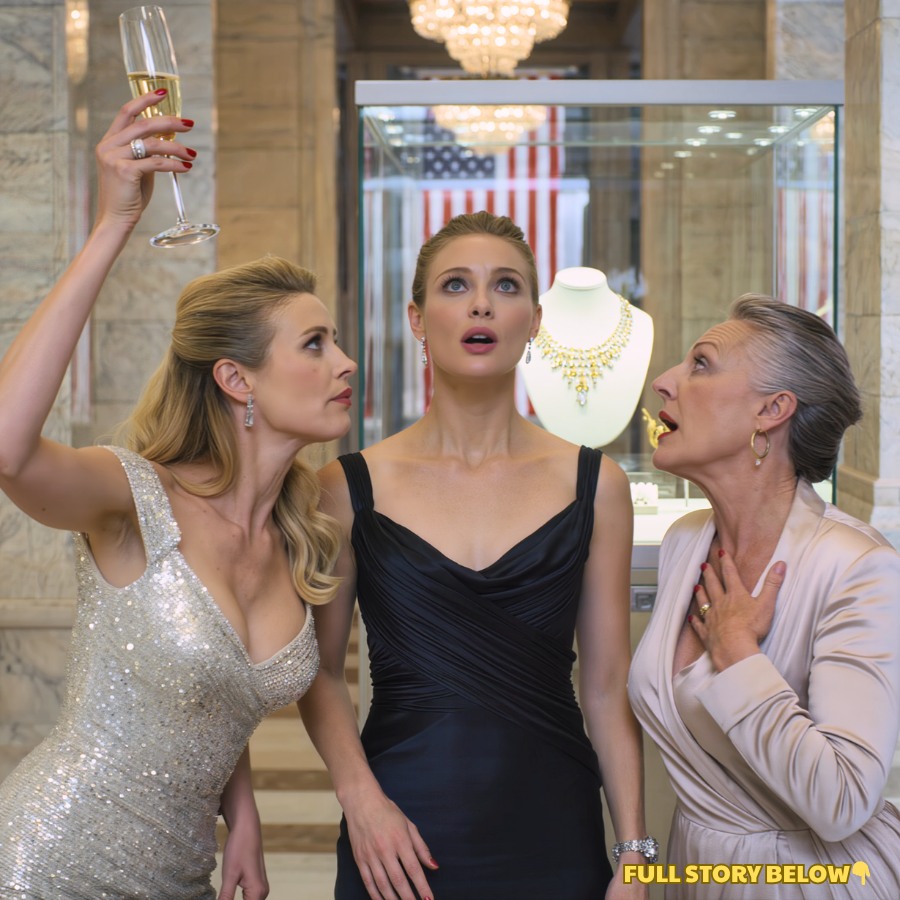
I fell asleep thinking about their faces when the velvet cloth came off the glass case.
The next day moved like a held breath.
By noon the museum had confirmed final security arrangements. By three I was in a suite upstairs while a stylist pinned my hair and someone from the donor relations team went over the evening schedule for the tenth time. At five the necklace was installed behind custom glass beneath museum lighting calibrated to preserve the metal and stones while making them glow. I stood in the empty hall and watched technicians adjust the angles until the diamonds gave off small, clean bursts of light like captured stars.
A gold plaque was placed beneath the case.
The Alcott Heirloom Necklace
Paris, circa 1941
Maison Delacroix
Donated by Emily Alcott
I read my name there and had to blink twice.
For so long my name had lived only in other people’s sentences. Emily never quite. Emily should have. Emily isn’t like Chloe. Emily means well. Emily has always been a little… difficult. Seeing it on that plaque, clean and dignified and attached to something undeniable, felt like watching my reflection come into focus after years of distortion.
At six-thirty the first guests arrived. Trustees. Curators. Donors. Journalists. Historians. People whose eyes sharpened, not dulled, in the presence of beauty. The air inside the Metropolitan Museum Hall was all warm gold and low conversation and the gentle clink of glassware. Marble columns rose like pale sentinels around the room. Floral arrangements in cream and deep green framed the central display. Waiters in black jackets moved like clockwork, carrying silver trays of champagne. Somewhere beyond the closed doors, photographers had begun to gather.
A young museum staffer named Lena adjusted her headset and approached me with a bright, controlled smile. “Ms. Alcott, the press is already here. We can begin introductions whenever you’re ready.”
I had chosen a dark silk gown, simple and severe, elegant enough not to compete with the story itself. I wore no necklace.
That absence felt important.
“Yes,” I said. “Let’s start.”
Minutes later, from just inside the entrance, I saw the black SUV pull up at the curb.
My mother emerged first, one hand on the door frame, the other gathering the folds of a tailored evening gown that probably cost more than I made in three months at the boutique. Chloe stepped out after her in silver sequins that flashed with every movement, her face already arranged into the expression she used for social events: bored, beautiful, superior. My father came last, adjusting his tie and scanning the building with the wary confusion of a man who had spent his whole life walking into rooms designed by his wife.
Even from a distance, I could see they were talking. Laughing, maybe. The kind of casual preening people do when they assume the night will bend around them.
Then they stepped through the museum’s glass doors and the room rearranged itself.
Not for them. For me.
Lena turned toward me. A photographer pivoted. One of the trustees broke off mid-sentence to greet me. Across the hall, a curator raised a hand in recognition. Heads turned, not because I was the daughter or sister of anyone who mattered in that room, but because I was the reason the room existed tonight.
I watched confusion hit Chloe first.
Her gaze flicked from the floral arch to the crowd to the press cameras, then landed on me standing near the center of the hall while a museum representative spoke into my ear. She slowed. My mother slowed with her. My father’s brow furrowed.
“Wait,” Chloe said. I could read it on her lips before I heard it. “This can’t be her event.”
My mother gave a tiny dismissive shake of the head. “Relax. She probably volunteered to help with the catering.”
If that line had reached me the night before, it might have hurt. Now it barely touched the surface. They were standing under chandeliers worth less than the necklace they’d called fake, and still they could not imagine me as the center of anything.
I walked toward them.
“You made it,” I said.
My mother blinked. The practiced poise she carried into every room faltered, just slightly. “Well, of course. Your email sounded… important.” Her eyes swept the hall again, taking inventory. “Emily, what exactly is going on here?”
“You’ll see,” I said. “Please, enjoy yourselves until the presentation starts.”
I let that linger a moment, then turned away before she could regroup into control. Behind me I could feel their stillness, the subtle humiliation of being left standing in the middle of a room they did not understand while strangers nodded respectfully at the daughter they had spent years reducing.
The event built itself around them like weather.
Everywhere they looked, evidence gathered. Guests stopping to introduce themselves to me. A curator thanking me for my generosity. The museum director himself crossing the floor to shake my hand. Press photographers capturing arrival shots with my name written on the backdrop behind me. Chloe tried to ask one of the donors what the evening was for and got a vague smile in return. My mother’s eyes kept snagging on the event program, where my name appeared in elegant serif type beneath the museum crest.
Emily Alcott, donor and host.
I moved through the evening with a calm that surprised even me. I spoke with scholars about provenance. I answered a journalist’s question about why I had chosen public donation over private sale. I listened as one historian described the Delacroix collection as “a missing fragment of wartime artistic survival,” and felt Grandma’s note echo again in my mind. Some things must disappear to survive.
At seven-thirty, the lights shifted.
Conversation thinned. The string quartet softened and stopped. Museum staff guided guests toward the center of the hall, where a small stage stood near the shrouded display case. The cloth covering it was deep velvet, almost black under the gold lights. My family drifted closer with everyone else, though not from understanding. They moved with the uncertain caution of people who sense that the floor beneath them is not stable but have not yet discovered why.
Then Mr. Reynolds, the museum director, stepped onto the stage.
He was a warm-faced man in his sixties with a voice designed by God for microphones and fundraising. The room quieted instantly.
“Ladies and gentlemen,” he began, “thank you for joining us this evening for a remarkable occasion.”
His voice carried through the hall, rich and measured. “Tonight we honor not only a rediscovered treasure, but a story of preservation, courage, and extraordinary generosity. The object we unveil was long believed lost to history. Its survival bridges continents, decades, and one of the darkest chapters of the twentieth century. It comes to us thanks to the insight, care, and generosity of a remarkable woman.”
He turned toward me.
“Ms. Emily Alcott.”
The applause hit like thunder.
For one breath I could hear nothing else. Not the cameras, not the chandeliers, not the blood in my ears. Just that sound, rising around me, clean and public and impossible to take back. I looked instinctively toward my family.
My mother’s jaw had actually dropped.
Chloe blinked as if her face had forgotten how to arrange itself. My father looked from the stage to me and back again, his expression stunned in a quieter, sadder way, like a man realizing how much he had failed to see while standing three feet away from it for years.
Mr. Reynolds lifted a hand toward the draped case behind him.
“And now,” he said, “we reveal the Alcott heirloom necklace. Paris, circa 1941. Estimated value, two point eight million dollars.”
A sharp collective breath moved through the hall.
The velvet cloth rose.
Light flooded the necklace from three angles at once, and suddenly it was no longer the small private beauty I had worn tucked against a blouse or sweater. Under glass, against black velvet, it became what it had always been: deliberate, luminous, breathtaking. The gold seemed to hold its own inner warmth. The diamonds scattered brilliance without vulgarity. It did not sparkle like something trying to be noticed. It glowed like something that had never needed permission.
The room gasped.
It was a real sound, involuntary and human, one I will never forget.
But I was not watching the necklace. I was watching them.
Shock came first. Then confusion, because their minds still rejected what their eyes were telling them. Then recognition. And after that, something harsher and more naked than either of them had probably felt in years.
Regret.
My mother’s hand rose to her chest as if she’d been struck.
“That’s your necklace?” she whispered.
I turned to her with the calmest voice I had ever possessed. “The fake one, remember?”
Her lips parted, but no answer came.
Chloe stared at the case, then at me, then back at the case. “You… you donated this?”
“Yes.”
“You knew?” she said. “All this time, you knew?”
I took one small step closer. “I knew. I just didn’t feel the need to prove it until you made it clear that humiliation was your language.”
The words landed. I saw them land. Chloe flinched the way people do when the truth finds the exact seam in their armor.
Onstage, Mr. Reynolds continued speaking about the collection, the provenance, the necklace’s historical significance. He called it a symbol of legacy and integrity. He praised the donation as an act of preservation. Then he turned and invited me up to the microphone.
I remember the walk to the stage more than the speech itself. The feeling of fabric against my legs. The cameras lifting. The awareness of every eye in the room. My own heartbeat, steady for once. No tremor. No shrinking. No urge to apologize for existing before I began to speak.
I stood behind the microphone and looked out over the crowd.
My family stood near the front, arranged by accident into a tableau so perfect it might have been staged: my mother pale and rigid, Chloe unraveling beneath the sequins, my father quiet and stricken. Behind them the necklace burned under glass.
“Thank you,” I began.
My voice sounded clear. Stronger than I felt, or maybe stronger because of everything I had felt and survived.
“When I first found this necklace, I was told it might not be worth anything,” I said. “That it looked too plain to be valuable.”
A soft ripple of knowing laughter moved through the audience, because people recognized metaphor when it arrived dressed in silk.
“But sometimes,” I said, letting my gaze travel slowly across the room until it reached my family, “the most extraordinary things are overlooked. Not because they lack worth, but because people refuse to look closely.”
Stillness.
“Value isn’t defined by appearance,” I continued. “Or by fashion. Or by who happens to be speaking the loudest in the room. It’s defined by truth. By history. By craftsmanship. By what survives when everything superficial has fallen away.”
I could feel the words working beyond the room, beyond the necklace, beyond the event itself. They were about metal and history and war and inheritance. They were also about me.
“And tonight,” I said, “that truth finally shines.”
The applause that followed was enormous.
Not polite. Not charitable. Genuine.
I stepped away from the podium while the room still clapped and returned to the floor with my spine straight and my pulse steady. It felt, for the first time in my life, as though the air around me had changed density. As though the version of myself they had forced me to carry for so many years had simply burned away in public and left something cleaner behind.
As I passed my family, my mother reached out and lightly caught my wrist.
“Emily.”
Her voice had gone soft in the way it only did when she was frightened.
“We didn’t know,” she said. “You should have told us.”
I met her gaze. “You never ask.”
For a moment she looked smaller than I had ever seen her. Not physically. Internally. As if some structure she had relied on for decades—some belief about herself, about me, about what determined value—had cracked down the middle.
Chloe swallowed hard. “Was this all just to teach us a lesson?”
I looked at her, really looked at her, without the old fear.
“No,” I said. “This was to remind you that respect isn’t inherited. It’s earned.”
Then I moved past them and into a wave of journalists, donors, curators, and museum staff, while behind me flashbulbs went off in rapid succession, capturing exactly what I knew would haunt them: their faces beside the plaque bearing my name.
The formal part of the gala ended late, but the emotional wreckage started immediately.
Guests dispersed into clusters of conversation while the quartet resumed and waiters refilled champagne glasses. People came to congratulate me. A historian from Columbia asked whether I had considered endowing a scholarship in my grandmother’s honor. A donor complimented the speech. A reporter requested a statement for the morning edition. I answered what I could and deflected what I preferred to keep private. Each exchange built the reality more solidly around me. It was no longer a dramatic reveal. It was fact. Documented, insured, cataloged, applauded.
My family had to stand inside that fact.
I found them again twenty minutes later near the display case. Chloe stood so close to the glass her reflection floated over the necklace like a ghost version of herself, all sequins and stunned disbelief. My mother still held her clutch with both hands, fingers white against the satin. My father stood a little apart, not because he was detached, but because he seemed unsure he had the right to occupy the same air.
“Two point eight million,” Chloe said, almost to herself. “You’re lying. There’s no way.”
“Ask the museum,” I said. “They verified every detail.”
My mother turned to me with eyes that were no longer proud or superior, but openly scrambled. “Emily, we didn’t mean to—”
“Didn’t mean to what?” I cut in.
My voice remained calm, which somehow made it sharper.
“Didn’t mean to humiliate me in front of the family? Didn’t mean to call me worthless every time I tried to build something for myself? Or didn’t mean to assume your approval defined my worth?”
She opened her mouth, but nothing came. For once there was no elegant phrasing, no polished defense, no turn of language that could make cruelty sound maternal.
Around us, people drifted by in pairs and quiet groups. I noticed two relatives from my mother’s side standing across the hall pretending not to stare. I noticed the way my aunt suddenly smiled at me whenever our eyes nearly met, as if she could revise ten years of silence by widening her mouth.
Mr. Reynolds approached with two board members beside him.
“Ms. Alcott,” he said warmly, “congratulations again. The board is thrilled. They would love to discuss future collaborations with you. Possibly a charitable foundation or an annual preservation initiative under your name, if that interests you.”
Under your name.
Continue reading by clicking the button (Continue Reading »») below!