
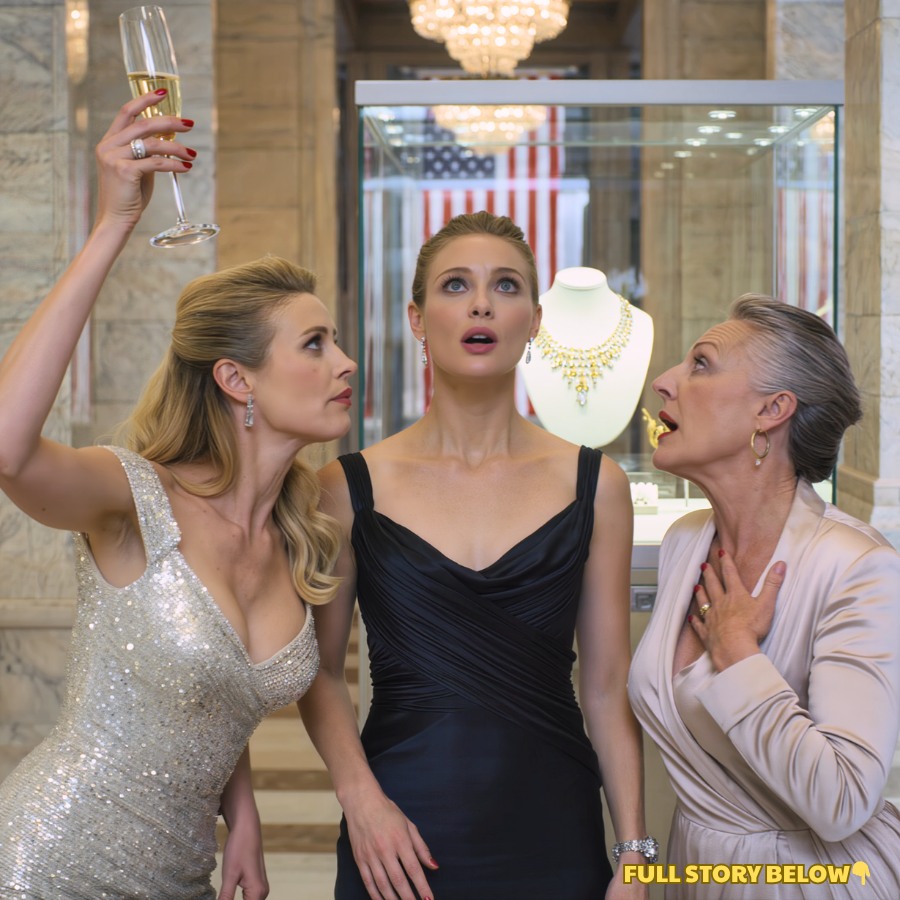
The phrase landed differently this time. Less like vindication, more like possibility.
“I’d be honored,” I said. “Let’s schedule something next week.”
He smiled and moved on.
Chloe stared after him, then at me. “You’re working with them now?”
“Actually,” I said, “I’ve been working with them for months.”
Her face changed with each word.
“I just didn’t mention it because you probably would have called it another one of my fake jobs.”
That one hit.
Not because it was clever. Because it was true. Chloe’s entire identity relied on assumptions she had never needed to examine. Expensive equaled superior. Loud equaled confident. Public approval equaled personal value. And beneath all of it, the simplest assumption of all: that I would always remain available beneath her, someone to diminish whenever she needed to feel taller.
“So all this time,” she said, “you knew. You planned this.”
“I didn’t plan you,” I said quietly. “You handed me the moment yourself.”
She flinched, then anger arrived to protect what humiliation had exposed. “That’s cruel.”
I stepped closer so only she could hear me.
“You do not get to talk to me about cruelty, Chloe. You’ve built your whole personality around belittling people. Every dinner, every holiday, every chance you got, you needed someone smaller to stand next to so you could feel big. Well, congratulations.”
I tilted my head toward the display case, toward the crowd reading the plaque, toward the low hum of people saying my name with admiration.
“Tonight, you finally got the attention you wanted. Just not the kind you expected.”
For a second I thought she might slap me. Not because she was brave, but because people like Chloe often reached for spectacle when they ran out of control. But she looked around, saw the guests, the cameras, the museum guards, and understood too late that the room belonged to me, not her.
She turned and walked away fast, heels striking marble like thrown knives.
My mother stayed.
That surprised me.
She watched Chloe disappear through the crowd, then slowly turned back to me. In the years when I was growing up, I had imagined this moment in dozens of forms. I thought if my mother ever finally saw me—really saw me—I would cry, or rage, or ask all the questions children carry into adulthood when love has always come tangled with injury. Why wasn’t I enough? Why did you enjoy it? Why did you always join her? Why did you never stop when you knew it hurt?
But when the moment came, what I felt was not hunger. It was distance.
“Emily,” she said, and her voice cracked on my name.
She almost never used my name that way. Usually it was sharpened by instruction, disappointment, correction. Now it sounded fragile.
“We made mistakes.”
I nodded once. “You did.”
Tears gathered in her eyes. I could not remember the last time I had seen her cry. Maybe at Grandma’s funeral, though even then it had been brief and controlled.
“Can we start over?” she asked.
There it was. The sentence I had once spent whole nights imagining. The question that, years ago, would have shattered me with hope.
Instead it landed like something arriving after the store had long since closed.
I looked at her for a long moment. At the diamonds in her earrings. At the perfect set of her hair. At the fine lines age had etched beside her mouth while she was busy teaching herself to be elegant enough to outrun tenderness. At the fear in her face now that she no longer understood her position.
“I don’t hate you, Mom,” I said softly. “But I’ve stopped needing you to see me.”
That was when she began to cry for real.
Not dramatically. No grand collapse. Just a sudden loss of composure, a wetness she could not blink away fast enough. She looked at me as if she were finally meeting an adult where she had expected to find the daughter she could still shape.
I turned before pity could talk me into softness I had not been offered when I was the one begging, silently, to be spared.
In the glass of the display case I caught my reflection beside the necklace. My name shone beneath both of us. For the first time in my life I did not see the outcast daughter, the cautionary tale, the quiet girl with the unimpressive job and the wrong clothes and the habit of choosing old things over new status symbols. I saw someone else entirely.
Someone underestimated.
Someone who had survived being underestimated long enough to make it useful.
Later, when the last speeches ended and the event began to thin, I stepped outside onto the museum steps.
The city air was cold and crisp against my skin. Below me, headlights drifted through the avenue like streams of white gold. Cameras still flashed near the curb where a few reporters lingered. The museum doors opened and closed behind me, releasing warm air, snatches of music, low conversation.
I stood there and exhaled.
Not dramatically. Just once, deeply, as if my body had been carrying a weight for so long it had forgotten it could put one down.
Behind me, a photographer called my name and I turned automatically. The flash hit. Another followed. In the distance, near the doors, I glimpsed my mother speaking to a relative with the rigid posture of someone trying to contain disgrace. Somewhere inside, Chloe was likely rewriting the story in her head already, searching for the version where she had not become the villain of her own evening. My father stood alone near a column, hands in his pockets, watching me with an expression too complicated for me to read from that far away.
Every flash, every whisper, every stunned face—it was more than validation. It was a form of justice, not because it humiliated them, though it did, but because it removed their power to define the story. Publicly. Irrevocably. No more family narrative about poor Emily with her misguided choices and cheap taste and lack of ambition. No more indulgent smiles over wine. No more using me as the room’s easiest punchline.
They had spent years treating me like a shadow.
Tonight the light had made that impossible.
I stayed only a few minutes longer, then slipped into a waiting car arranged by the museum and went home.
Sleep came strangely. Not fast, but clean. When I closed my eyes I did not replay the insults. I replayed the unveiling. The gasp. The look on my mother’s face. The moment my own voice filled the microphone and did not tremble. Some bruises heal the instant the truth is spoken aloud in the right room.
Morning arrived bright and unapologetic.
Sunlight poured through my curtains in hard golden stripes, and when I reached for my phone on the nightstand, it was vibrating with notifications. Texts. Emails. Social media mentions. Missed calls. Article links. Someone from the boutique had sent six exclamation points and a screenshot of a local news story. A college friend I hadn’t spoken to in years wrote, Is this YOU?? A former teacher sent, Your grandmother would be so proud.
By the time I opened a browser, the story was everywhere locally and starting to spread nationally.
Local Woman Donates Lost $2.8 Million Artifact
Rare Wartime Necklace Resurfaces Through Family Heirloom
Emily Alcott and the Rediscovery of a Delacroix Masterpiece
Every article used the same image: me standing beside the glass display, composed and unsmiling, the necklace blazing under museum lights. In the blurred background, if you knew what to look for, stood my mother and Chloe, their faces pale with disbelief. The internet, with its gift for narrative symmetry, had already started doing what it does best. People loved a reveal. They loved poetic justice. They loved the idea that something mocked at dinner could end up under museum glass by morning.
My phone buzzed again.
My mother.
Emily, we’re proud of you. We didn’t realize what that necklace meant. Can we talk?
A minute later, Chloe.
Hey. I said some awful things. You didn’t deserve that. Maybe we can start over.
I stared at both messages for a long time.
Pride. An apology. A request.
Years of me would have run toward that. The younger version, the one who used to sit outside in the car after dinners swallowing tears because she still believed if she became accomplished enough or elegant enough or useful enough they would soften, would have answered immediately. She would have accepted scraps and called them healing.
But sitting there in my apartment with morning light on the floor and my own name spreading through headlines that had nothing to do with my family’s approval, I felt something far quieter and stronger.
Peace.
Not triumph. Not revenge. Peace.
It is a deeply unsettling thing to realize the people who hurt you no longer have access to the younger self who begged for their kindness. They arrive ready to negotiate with a wound and find instead a scar. Closed. Changed. No longer open for instruction.
I set the phone down and went to the window.
From my apartment I could see part of the museum’s glass roof in the distance, catching sunlight. The city was already moving—buses, delivery trucks, pedestrians with coffee and hurried steps, the ordinary machinery of life continuing as if the night before had not rearranged mine. I thought about the dinner table again. About Chloe’s wine glass and my mother’s napkin and my father cutting steak while I was being turned into a joke. I thought about how many times I had believed my silence was grace when in fact it had been training.
Someone knocked on my apartment door.
That startled me enough that I froze for a second, phone still in hand. I wasn’t expecting anyone. When I opened the door, my father stood there.
He looked tired. Not messy, because he never allowed himself that, but looser somehow. His tie was gone. His coat hung open. There were shadows under his eyes.
“Can I come in?” he asked.
I stepped back. “Sure.”
He entered slowly, as if unsure he had permission not just in my apartment but in this new version of our relationship neither of us yet understood. He sat on the couch while I remained standing for a moment, then took the armchair opposite him.
He looked around the room. My books. The framed sketch by Grandma on the wall. The stack of museum catalogs on the side table. The teacup I had forgotten in the sink. It occurred to me that my father had probably never paid real attention to where or how I lived. Not because he didn’t care exactly, but because caring required a kind of active seeing he had spent his marriage avoiding.
“I saw everything,” he said finally. “The necklace. The articles.”
I waited.
“You did good, Em.”
Em.
He used to call me that when I was little, before silence replaced intimacy and passivity replaced protection.
“Thanks,” I said.
He rubbed his hands together once, then looked down at them. “Your mother’s been crying all morning. Chloe too.”
I folded my arms. “I imagine last night was uncomfortable for them.”
His mouth tightened, not in disagreement. “You hit them hard.”
I let that sit between us. Then I said, “They hit me first. Repeatedly. For years.”
“I know.”
Two words. Quiet. Immediate.
I don’t think he understood how shocking they were.
My father had built his entire adult life around strategic absence. He was never the one making the cruel joke. Never the one raising his voice. Never the obvious aggressor. He simply failed to interfere so consistently that his neutrality became its own kind of violence. He had never once said I know.
He looked up. “And I should have stopped it. I didn’t.”
The room changed.
Maybe it was the stillness in his face. Maybe it was the lack of excuse. Maybe I had spent so many years braced for denial that simple accountability felt like a crack opening in a wall.
He exhaled slowly. “Your mother grew up believing money was everything. Not just comfort—proof. Proof that you mattered. Proof that you’d won. She poured that into Chloe. Into this whole family. And I… let her. Because it was easier. Because I told myself your mother was strong and you were strong and the conflict would pass and none of it was as bad as it looked.” His jaw worked. “But it was.”
I didn’t interrupt.
He looked around my apartment again, more carefully this time. “You’ve built a life, Emily. Maybe not the life your mother respects. But a real one. You’ve got heart. Taste. Discipline. You see things the rest of us miss.” His eyes came back to mine. “You always did.”
Something tightened in my throat.
Praise from him should not have mattered as much as it did. Yet there it was, an ache opening under my ribs. We are rarely as healed from parental silence as we imagine.
“You proved them wrong,” he said. Then after a beat, “More than that. You proved yourself right.”
I looked down because suddenly my eyes were burning.
“Thanks, Dad,” I said, and for the first time in years the words felt like they belonged to an actual relationship rather than a formality.
He nodded once. There was shame in his face, but also relief, as though saying it had cost him something he should have paid long ago.
When he stood to leave, he paused by the door.
“You did what I never could,” he said quietly. “You made them listen.”
After he left, the apartment became very quiet.
I sat on the couch and stared at the closed door for a long time. Then I picked up my phone again. My mother’s message still waited. Chloe’s too. New ones had arrived from cousins and aunts and people I hadn’t heard from in years, each one glowing with the sudden affection success so reliably inspires in those who treated obscurity like a flaw.
I typed slowly.
I forgive you, but I’ve moved on.
I sent the same message to both my mother and Chloe.
Then I set the phone facedown and let the silence return.
It did not feel empty. It felt clean.
Continue reading by clicking the button (Continue Reading »») below!