
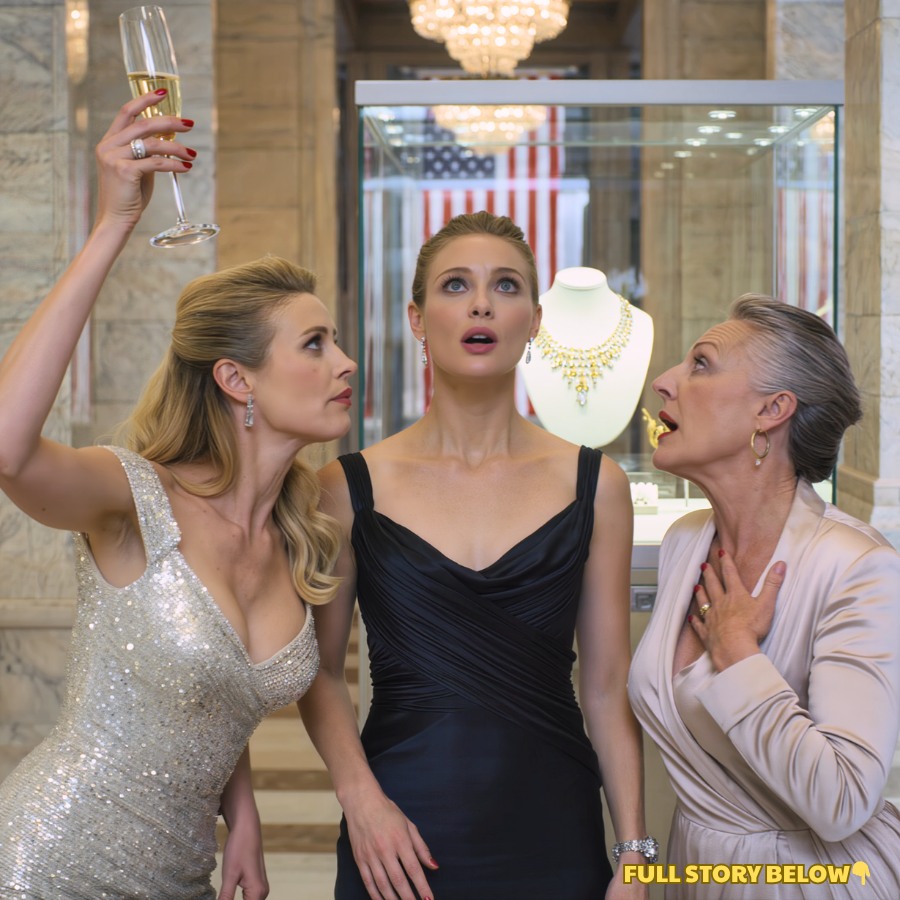
Later that afternoon I opened the top drawer of my dresser and took out a small velvet box. I had picked it up from a jeweler the week before the gala: a replica based on the original necklace’s design, made in simple gold with careful workmanship and modest stones. It was never meant to replace the real thing. Nothing could. But I wanted something of the shape and memory without the burden of secrecy and insurance and armed transport.
I lifted it from the box.
Even as a replica, it was beautiful.
I fastened it around my neck and walked to the mirror.
For a moment I just stood there, seeing myself with the outline of the old necklace returned to its familiar place. But the girl in the mirror was not the girl from dinner. She was not the one shrinking under jokes or rehearsing gentleness to survive the next family event. Her face looked the same, yes. Same eyes. Same mouth. Same dark hair pinned loosely back. But something essential had altered.
Not because the world now recognized my worth.
Because I finally understood that it always existed before recognition arrived.
That was the part the gala gave me. Not revenge, though there had been satisfaction in abundance. Not even justice, though there had been that too. What it gave me was an irreversible severing from the need to be believed by people who had committed themselves to misunderstanding me.
I touched the replica lightly at my throat.
Outside, the city moved fast and bright. Delivery bikes slipped through traffic. Children shouted in the street below. Someone somewhere practiced scales on a piano badly and with great commitment. Life, indifferent and generous, kept unfolding.
Over the next week, the story only grew.
The museum released a formal statement about the donation and the necklace’s provenance. A historical design journal requested an interview. The boutique where I worked saw a sudden flood of curious customers after one local reporter described me as “a resale specialist with an eye for hidden histories.” Simon called to say several colleagues had reached out to congratulate him on helping authenticate the piece. “You handled this beautifully,” he said, and I could hear the real admiration underneath his formal tone. “Your grandmother would be proud of how you honored the necklace.”
That sentence stayed with me.
I thought often about Grandma Eleanor in those days. About her note. About the possibility that she had carried that necklace through a world on fire and then hidden it among overlooked things because she understood something my family never had: that not all value is safest when displayed. Some value survives because it learns discretion. Some beauty stays alive by refusing spectacle until the right moment arrives.
I visited the museum twice in private hours before the exhibition opened to the public.
The first time, I went alone. Mr. Reynolds arranged for me to walk through the hall before visitors entered. The lights were softer without the gala setup, and the necklace rested in its case with an almost solemn presence. Without cameras and champagne and my family’s humiliation electrifying the room, it felt quieter. More intimate. History reclaimed from performance.
I stood before it and read the plaque again.
Donated by Emily Alcott.
A museum conservator joined me and explained the mounting process, the humidity controls, the archival research still ongoing into wartime Delacroix commissions. She spoke with reverence, not because the necklace was expensive, though that mattered in practical terms, but because its survival carried witness. It connected names, choices, migrations, losses. It had lived through danger. That was why it mattered.
I pressed my fingertips lightly to the edge of the case—not enough to smudge the glass, just enough to anchor myself in the moment—and whispered, “Hi, Grandma.”
The second visit I brought my father.
He asked quietly, almost shyly, whether he could see it without the crowd. I nearly said no out of instinct. Then I saw the effort in him and agreed.
We walked through the exhibition side by side. He read every panel. He stood in front of the necklace for a very long time. At one point he said, “Your grandmother used to sketch in that little blue notebook at the lake house. I remember that.” Then after another silence: “I didn’t know she’d lived so much before us.”
I almost answered, None of us knew. But that wasn’t true. Grandma had tried. She had told stories, shown us drawings, spoken about Paris and war and art and courage and beauty. It was just that most of the family only listened when money entered the sentence.
“She knew how to hide things,” I said instead.
He nodded. “Maybe she had to.”
When we left the museum, he did something small and clumsy and devastating: he put his hand briefly on my shoulder. Not to guide me. Not to move me aside. Just because he wanted to touch his daughter kindly. I nearly cried on the sidewalk.
My mother called three days after the gala.
I considered ignoring it. Instead I answered.
“Emily?” she said, too quickly, as if she feared I might hang up if she paused. “Thank you for responding to my message.”
“You’re welcome.”
Silence. Then, “I meant what I said. I’m proud of you.”
Pride. The old bait. The thing I used to starve for.
“I believe you,” I said.
She seemed thrown by the absence of resentment in my tone. Maybe she had prepared for anger and did not know where to place sincerity.
“I’d like to see you,” she said. “Just for coffee. No drama.”
I looked out the window while she waited.
Below, someone was walking a dog in a tiny red sweater. A delivery truck was unloading crates of flowers at the corner market. The world did not pause for family reckonings.
“I’m not ready,” I said.
A small inhale on the other end. “Will you ever be?”
That was the question beneath all of it. Not Can we talk. Not Are you proud. Not even Can we start over. The real question was whether access to me could be restored once regret arrived.
“I don’t know,” I said honestly. “That depends on what you’re asking for. If you want absolution because you’re uncomfortable, no. If you want a relationship, that would require change. Real change. Not because I donated a necklace. Because of how you’ve treated me for years.”
She was quiet long enough that I thought the call had dropped.
Then: “You sound like your grandmother.”
I almost laughed. “That’s the nicest thing you’ve ever said to me.”
A sound escaped her then—not quite a laugh, not quite a sob. “I suppose I deserve that.”
“Yes,” I said. “You do.”
We ended the call politely. Nothing was solved. But for once, nothing had been distorted either. That felt like progress, though not the kind that guaranteed reunion.
Chloe did not call. Chloe sent messages in bursts, as if apology were a brand she was trying on.
I’ve been doing a lot of thinking.
I know I’ve been hard on you.
I didn’t realize how bad it looked from your side.
Can we grab lunch?
Mom’s really upset.
I’m upset too, by the way.
That last line was so pure Chloe I almost admired it. Even in remorse she wanted center stage.
I did not answer immediately. Eventually I sent one line.
Being upset is not the same as being accountable.
She did not reply for two days.
Then came a text at eleven at night.
You always thought you were better than us.
I stared at it and smiled—a real, astonished smile, because there it was at last, the honest core beneath all the sequins and sarcasm. Not superiority. Fear. Chloe had sensed, perhaps for years, that my worth did not operate on the same system as hers and that if anyone ever noticed, the hierarchy she relied on might collapse.
I locked the phone without answering.
At the boutique, my life became oddly public. Customers arrived pretending to browse scarves while sneaking glances at me. One woman brought her teenage daughter in and whispered loudly enough for me to hear, “That’s her, the museum girl.” My boss, Marianne, who had always believed in me without fanfare, simply handed me a price gun one morning and said, “Fame won’t tag these for you.” Then she winked.
One afternoon after closing, she poured us both tea in paper cups and leaned against the counter.
“So,” she said, “what now?”
I looked around the boutique—the old brass mirror near the dressing area, the racks of silk blouses sorted by decade, the glass cabinet of antique buckles and cameos, the faint smell of cedar and steam from the back room where we repaired garments. I loved this place. But for the first time, I could imagine building something adjacent to it, larger than it. A conservation studio. A foundation. A scholarship. A life not confined by proving my family wrong, but expanded by proving myself useful to the world I actually cared about.
“I think,” I said slowly, “now I stop thinking in reaction to them.”
Marianne nodded once as if I had finally reached the only conclusion worth reaching.
The museum board invited me to dinner the following week. Not family dinner this time, but a long table filled with people discussing preservation, education, public access, and philanthropy in the language of serious intent. They asked about my grandmother. They asked about my interest in object histories. They asked whether I would consider funding research into displaced wartime design or creating a grant for young conservators from working-class backgrounds. No one there treated me like a novelty. No one seemed surprised that I had ideas.
When I spoke, they listened.
That still startled me.
Afterward, on the ride home, I thought about how little money itself had moved me compared to the shift in agency. Two point eight million dollars attached to a necklace was a headline. But the real transformation was subtler. It was the right to step into rooms I had been trained to think belonged to other people. The right to speak without shrinking. The right to decide what legacy meant outside the vocabulary of status my mother had worshipped.
I began the paperwork for the Eleanor Alcott Preservation Initiative before the month was over.
The foundation would support research, restoration, and scholarships related to overlooked decorative arts and objects with displacement histories—pieces lost, hidden, misattributed, or dismissed because the world had not looked closely enough. It felt exactly right. It felt like turning the deepest pattern of my life into a kind of offering.
When the museum announced the initiative publicly, they asked for a quote. I gave them one line.
Some of the most important things in history survive because someone refused to mistake quiet for insignificance.
The quote was printed beneath my photograph in a culture column. My mother clipped it and mailed it to me without a note. I found that almost unbearably sad.
Spring edged toward summer. The exhibition opened to the public and attendance surged. School groups came through. Scholars requested access to new archival materials generated by the necklace’s reappearance. I visited less often, not because it mattered less, but because I no longer needed to stand in front of the case to remember what had changed.
The biggest shift had happened inside me, and it stayed.
Family gatherings became negotiable.
The first one I skipped was my aunt’s anniversary brunch. My mother texted, Are you coming? Everyone will ask for you.
That alone told me more than enough.
I replied, Not this time. Send my regards.
The second was Father’s Day, which I did attend because my father asked me personally. The atmosphere at the table was different from the moment I arrived. Softer on the surface. Overcareful. Several relatives complimented me too quickly. My aunt asked leading questions about the museum in a voice pitched too high. Chloe, for once, said very little. It would have been tempting to enjoy their caution. Instead I found it sad. Fear is not the same as respect either.
At dessert, an uncle I barely tolerated said, “Well, I guess Emily always did have an eye for value.”
And there it was again—that instinct to rewrite history in a way that preserved everyone’s dignity except mine.
I put down my fork and said pleasantly, “No. You all assumed I didn’t. That’s different.”
The table went quiet.
My father looked at me, then at the others, and to my mild astonishment he said, “She’s right.”
No one challenged him.
That was the thing about truth once it had enough witnesses: it became much harder to smother.
After lunch Chloe followed me onto the porch.
She looked immaculate as ever, though something in her had gone less glossy. Not humble, not yet, but destabilized. That was something.
“I miss how things used to be,” she said.
I turned to face her. “You miss when I absorbed whatever you threw at me.”
Her eyes flashed. “That’s not fair.”
“It’s exactly fair.”
She crossed her arms. “I’m trying, Emily.”
I considered her for a moment. Behind us, laughter rose from the dining room where the rest of the family clung to politeness. Summer air stirred the hydrangeas beside the porch steps.
“Trying what?” I asked. “To be better? Or to get back access to the version of me that made you feel powerful?”
She looked away first.
That told me everything.
Continue reading by clicking the button (Continue Reading »») below!