
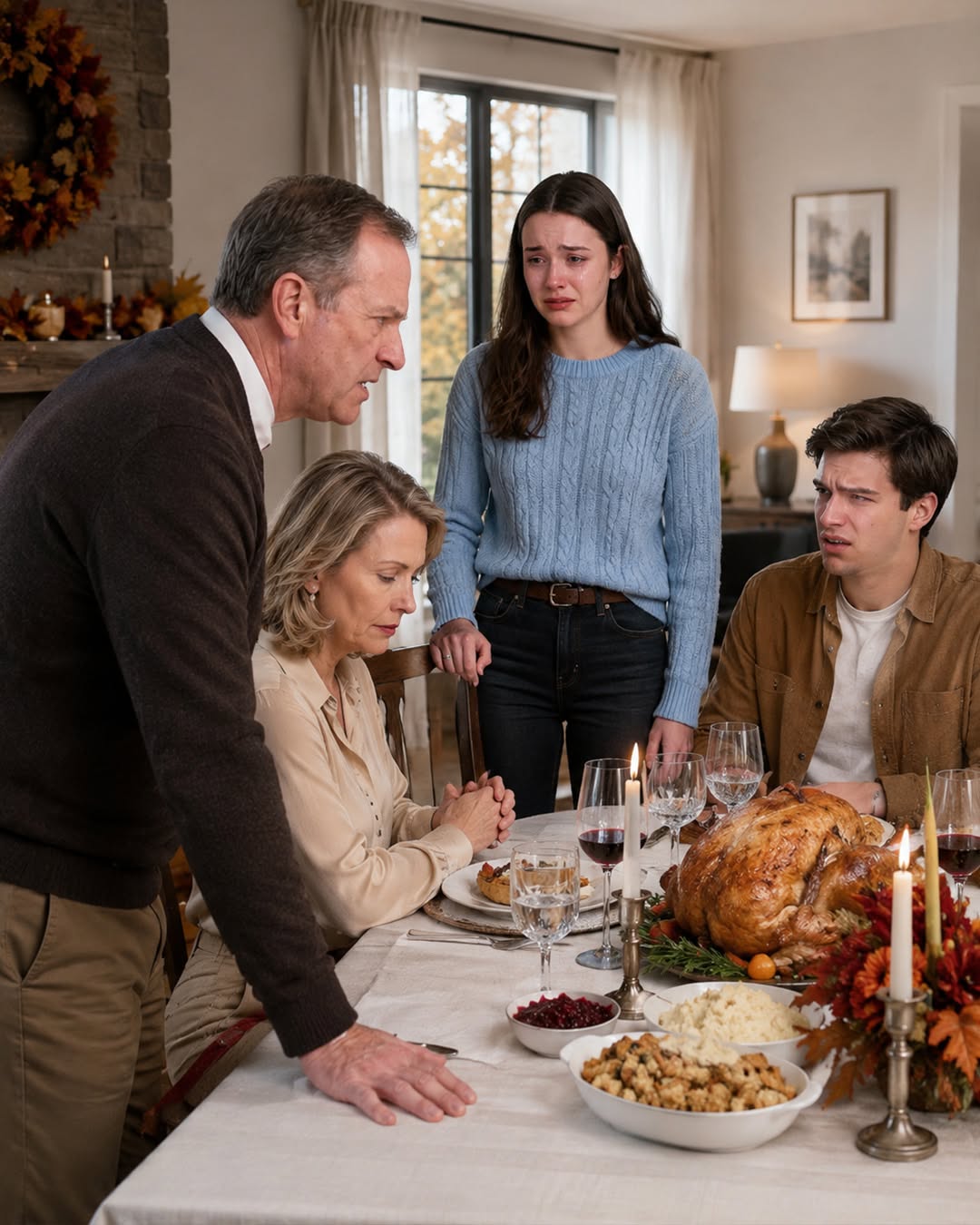
“I want to transfer to medical school.”
The table went silent. My father’s fork stopped halfway to his mouth.
“What?”
“I don’t want to be a lawyer. I want to be a doctor. I want to study neuroscience, maybe become a neurosurgeon. It’s what I’ve always wanted before we convinced you to go to Harvard Law.”
My father’s voice was cold.
“You’re throwing away the Marchand legacy for what? To be a glorified nurse?”
“Neurosurgeons aren’t nurses, Dad.”
“You know what I mean. You’re throwing away prestige, throwing away connections, throwing away everything we’ve worked for.”
Connor shifted uncomfortably.
“Dad, if Chloe wants to be a doctor, at least finish what you start, Chloe.” Connor’s voice was gentle, but the words cut deep. “Don’t be a quitter.”
A quitter. That word would haunt me for years. My mother hadn’t said anything. I turned to her, pleading silently for support, for understanding, for anything. She looked down at her plate.
“We told everyone you’re at Harvard Law, Chloe. What am I supposed to tell them now? That you failed?”
“I didn’t fail. I’m choosing a different path.”
“You’re embarrassing us.” My father’s voice was flat. “Do you know how that looks? Connor left law school to pursue business. You’re leaving because you’d rather play doctor. That’s not the same thing.”
I felt something inside me break, not dramatically, just a quiet crack, like ice on a frozen pond.
“I’m sorry I’m such a disappointment.”
My voice was steady, calm, empty. I left the table, packed my bags that night, and by December, I’d withdrawn from Harvard Law School. I sent my parents one email, “I’m leaving law school. This isn’t my path.”
My father called. He didn’t ask if I was okay. He didn’t ask what my plans were. He yelled.
“You’re embarrassing this family, do you understand that? Everyone knows you were at Harvard Law. What am I supposed to tell them?”
“Tell them I quit.” I was surprised by how steady my voice was. “Tell them I wasn’t good enough. Tell them whatever you want.”
“Chloe.”
I hung up, blocked their numbers, and for the first time in my life, I chose myself.
The next 3 years were the hardest of my life. I applied to Johns Hopkins Medical School and got in with a scholarship. But my parents didn’t contribute a dime. I worked three part-time jobs, coffee shop barista, tutoring high school biology, weekend lab assistant. I slept 4 hours a night. I ate ramen more meals than I cared to count, but I was happy, actually happy.
My family didn’t call, not once. No texts, no emails, just silence. In 2017, Connor got engaged. I received a wedding invitation in the mail, not a personalized envelope, but one addressed to current resident, like I was a stranger, like I’d never lived in that house.
I didn’t go to the engagement party. I knew I wasn’t wanted. Every year my parents sent out holiday cards, professional photos of the family in matching outfits. 2016, 2017, 2018, 2019, 2020. In every single one, I was cropped out or simply not invited to the photo shoot. The caption was always the same, “The Marchands, Connor, Harvard Law ’14, future attorney.” No mention of me.
It was like I died, but no one bothered with a funeral.
Connor’s wedding was in 2018. I didn’t receive a formal invitation. I heard about it from my grandmother, the only family member who still talked to me.
“Your mother said you’re too busy with whatever you’re doing now.” Grandma’s voice was apologetic. “I’m sorry, sweetheart.”
I sent a congratulations card and a $500 wedding gift, money I’d saved over 2 months. It came back a week later with a note, “We don’t need charity from quitters.”
That’s when I stopped hoping they’d come around.
By 2020, I was in my residency at Mass General, specializing in neurosurgery. It was the most competitive residency program in the country, acceptance rate under 1%. My mentor was Dr. Alan Cross, a legend in the field. For the first time in my life, I felt seen, valued, believed in.
My grandmother called in 2021.
“Connor is running for district attorney. Your parents are so proud.”
“That’s great for him.”
“He’s using the family name, your father’s connections. Chloe, you should—”
“I’m happy for Connor, Grandma, but I’m not part of that family anymore.”
The silence on the other end was heavy.
“That’s not true, sweetheart.”
“It is, and that’s okay. I’ve made my peace with it.”
Connor’s campaign was everywhere in 2022, billboards, commercials, his slogan, “Marchand Family Legacy, Justice Through Generations.” The campaign website featured photos of my father standing next to Connor, both in expensive suits. The about page mentioned growing up in a family of Harvard legacies, of learning the importance of justice at the dinner table. I wasn’t mentioned, not once.
Connor won the election in January 2023. My father called me for the first time in 7 years.
“Connor’s swearing-in ceremony is next month.”
No greeting, no how are you, how, just an expectation.
“It would look bad if you’re not there.”
Not an invitation, an obligation.
“I’ll think about it.”
“Don’t embarrass us again, Chloe.”
He hung up before I could respond. The week before the ceremony, my mother texted me for the first time in 8 years.
“Wear something appropriate. No need to tell people what you’re doing now.”
The subtext was clear. Don’t mention medical school. Pretend you’re still figuring life out. Be invisible.
I didn’t respond.
The day of Connor’s swearing-in arrived. I almost didn’t go. I stood in my apartment staring at my closet and asked myself why I was even considering it, but something pulled me there, not hope, not a desire for reconciliation, just closure. I needed to see them one more time as the person I’d become and know for certain that I’d made the right choice in walking away.
I wore a black pantsuit, professional but understated. I arrived at the courthouse alone. The ceremony was held in a grand courtroom with mahogany panels and high ceilings. At least 200 people filled the seats, politicians, lawyers, journalists, family friends.
I sat in the back row. No one saved me a seat. No one waved me forward. I might as well have been invisible.
The woman sitting next to me smiled politely.
“Are you with the DA’s office?”
“I’m his sister.”
Her eyebrows rose.
“Oh, I didn’t know Connor had a sister.”
Of course she didn’t. I’d been erased.
The ceremony began. Connor looked confident at the podium, handsome in his tailored suit. My parents sat in the front row, glowing with pride. My father kept glancing around the room, making sure people saw him. My mother dabbed at her eyes with a tissue.
Connor gave a speech about justice, about family values, about standing up for those who couldn’t stand up for themselves.
“I stand here today because of my family’s unwavering support,” he said.
The camera panned to my parents, not to me. I should have felt angry, hurt, something, but I just felt detached. Like I was watching a play about someone else’s family. Then I noticed the judge.
Honorable Judge Margaret Whitmore sat at the bench, presiding over the ceremony. She was in her late 50s, with silver hair and sharp, intelligent eyes. While Connor spoke, she glanced toward the back of the room, directly at me. Our eyes met for two, maybe three seconds.
I didn’t recognize her, didn’t know why she was looking at me. I figured it was just a coincidence, but her expression, there was something in it. Recognition? Gratitude? I didn’t understand.
The ceremony continued. Connor finished his speech to enthusiastic applause. There were handshakes, photographs, congratulations. My parents stood with Connor, forming a perfect family tableau. I stayed in my seat, invisible.
Then the judge stepped to the podium.
“Before we conclude,” Judge Whitmore said, her voice carrying clearly through the courtroom, “I have a personal acknowledgement to make.”
Connor sat down, expecting more praise. My parents straightened in their seats, proud smiles ready. I stayed in the back, wondering when I could politely leave.
“Two years ago,” the judge continued, “my husband was dying.”
The room quieted.
“An aneurysm had ruptured in his brain. We were told to prepare for the worst. The odds of survival were less than 15%, but a young resident, overworked, underpaid, barely 48 hours into a double shift, refused to give up.”
My heart started pounding.
No, it couldn’t be.
“She performed an 11-hour surgery that saved his life. She stayed with him through every complication, every setback. She never wavered. She never gave up.”
I remembered. Richard Whitmore, emergency surgery, November 2021. The attending surgeon had been stuck in traffic during a nor’easter. I was only a second-year resident, but someone had to operate. Every minute we waited, brain cells died. I’d never done a surgery that complex on my own, but I scrubbed in, I made the call, and I saved his life.
“That resident never asked for recognition,” Judge Whitmore said. “She rotated to another department before we could thank her. I’ve been looking for her for two years.”
The courtroom was completely silent. Judge Whitmore looked directly at me.
“Dr. Chloe Marchand, would you please stand?”
Time stopped. Every single person in that courtroom turned to look at me. 200 faces, 200 pairs of eyes.
I stood slowly, my legs shaking. My mother gasped, actually gasped. My father’s hand trembled against the armrest. Connor froze, his smile locked in place, confusion clouding his eyes.
“Dr. Marchand,” Judge Whitmore’s voice was steady, warm. “My husband is alive today because of your skill, your dedication, and your refusal to let impossible odds define the outcome. On behalf of my family, and on behalf of every life you’ve saved and will save, thank you.”
The courtroom erupted in applause. People stood. Everyone stood. A standing ovation. But I wasn’t watching the crowd. I was watching my parents.
My father’s hand shook. My mother’s breathing stopped, then came back in a sharp gasp. Connor’s confident facade cracked, confusion and shock written across his face.
Eight years of being called a quitter. Eight years of being erased from family photos. Eight years of being told I’d embarrassed them, shattered in 60 seconds.
Judge Whitmore continued, “I understand Dr. Marchand is here today to support her brother. Connor, you’re lucky to have a sister like her.”
Connor forced a smile.
“Yes. Yes, I am.”
His voice cracked slightly. My father didn’t clap. My mother clapped mechanically, her eyes fixed on the floor. Neither could meet the judge’s gaze.
As the applause died down, people started approaching me. Strangers, guests, lawyers, and politicians who moments ago had walked past me without a second glance.
“You’re a neurosurgeon?”
“I had no idea Connor’s sister was a doctor. Mass General? That’s incredible.”
I smiled politely, answered briefly, but didn’t elaborate. I didn’t need to perform. I didn’t need to prove anything. I just existed, fully, finally.
Behind me, I could feel my parents standing alone, watching. The guests who usually crowded around them were surrounding me instead. Connor’s big day had been overshadowed by a truth they’d spent eight years denying.
I wasn’t invisible anymore, and that changed everything.
During the intermission before the reception, I stepped into the hallway to catch my breath. My hands were still shaking, not from fear, but from the sheer surreality of what had just happened. A woman approached me, mid-30s, professional, with kind eyes.
“Dr. Marchand?”
I turned.
“Yes?”
“I’m Sarah Chen, Judge Whitmore’s clerk.” She extended her hand. “The judge would like to speak with you after the ceremony, if you have time.”
I was confused.
“I think there’s been some mistake.”
“No mistake. You saved her husband’s life. Richard Whitmore, November 2021, ruptured cerebral aneurysm.”
The pieces clicked into place. I remembered the surgery. I didn’t realize that he was married to a judge. Sarah smiled.
“They keep their personal lives private, but Judge Whitmore has been trying to find you for two years. You rotated to a different department before she could thank you properly.”
My throat tightened. For two years, I’d believed no one saw me. No one valued what I did. But Judge Whitmore had been looking for me. Had remembered.
“His recovery?” I asked. “How is he?”
“Complete. Full cognitive function. He went back to teaching last year, philosophy at Boston College. You gave him his life back.”
I felt tears prickling at the corners of my eyes. This was why I became a doctor. Not for recognition, but for this, knowing that somewhere in the world, a man was teaching philosophy to college students because I’d refused to give up on him.
“I’d be honored to speak with her,” I managed.
Sarah smiled.
“She thought you might be hesitant. She wanted me to tell you something.” She leaned closer. “She said, ‘Tell Dr. Marchand that being unseen doesn’t mean being unimportant. Some of us have been watching all along.’”
Those words broke something open in my chest. I’d spent eight years believing I was invisible. Believing that because my family didn’t see me, I didn’t matter. But I’d been seen all along. By professors, by mentors, by patients, by people whose lives I’d touched without even realizing it.
I just hadn’t been looking for their validation.
The reception began. I stood near the windows, holding a glass of water I hadn’t touched. The room buzzed with conversation. Politicians networking, lawyers exchanging business cards, family friends congratulating Connor. Then I saw my father walking toward me.
His expression was controlled, but I knew that look. Controlled anger, the kind that came with tight jaw muscles and clipped words.
“Chloe.”
He stopped in front of me.
“We need to talk.”
I didn’t move.
“About what?”
“You could have told us.”
“Told you what?”
“That I became a doctor.”
“I tried. You called me a quitter and stopped speaking to me.”
His voice dropped lower.
“That’s not fair. You left Harvard Law without your permission.”
I kept my voice level.
“You’re right. I didn’t ask.”
My mother appeared at his side. Her eyes were red. She’d been crying.
“We thought you were struggling,” she said softly.
“We didn’t know you were a doctor,” I finished. “You didn’t know because you never asked. When was the last time you called me not to demand I show up somewhere, to actually ask how I was?”
The question hung in the air. Neither of them could answer.
Connor joined us, his political smile fixed in place.
“Chloe, I think there’s been a misunderstanding.”
“No misunderstanding, Connor.” I looked at him directly. “I wasn’t invited to your wedding. I wasn’t in family photos. I was erased.”
“You left,” Connor said. “You walked away from the family.”
“I left law school. You all walked away from me.”
My father’s voice hardened.
“You embarrassed us. You were at Harvard Law. Do you know how that looks?”
And there it was. The truth beneath everything. It wasn’t about me failing. It was about how it looked.
“You’re right,” I said calmly. “I embarrassed you by choosing to save lives instead of upholding your image. I’m sorry I was such a disappointment.”
The sarcasm was evident, but my voice stayed steady. I’d practiced this conversation a thousand times in my head. Now that it was happening, I felt strangely calm.
My mother tried a different approach.
“Chloe, we’re proud of you. We just we wish you’d told us.”
I almost laughed.
“You’re proud now because a judge said my name in front of people who matter to you. Where was that pride when I called to tell you I got into Johns Hopkins? Oh, wait, I didn’t call because you’d already made it clear I wasn’t worth your time.”
“That’s unfair.” My father’s voice rose slightly. People nearby glanced over. He lowered it again. “We’re your parents. We always—”
“You were my parents,” I interrupted. “Now you’re just people I used to know who happened to share my last name.”
The words landed like stones in still water.
My father changed tactics.
“Chloe, let’s put this behind us. Come to dinner next week. We’ll start over.”
I looked at him, really looked at him, at the desperation in his eyes. But it wasn’t desperation for me. It was desperation for his image, for the narrative he’d built. The judge had publicly praised me, and now he needed to reconcile that with the story he’d been telling for eight years.
“I don’t need to start over,” I said quietly. “I already started eight years ago, and I’m exactly where I want to be.”
“You can’t just walk away from your family.” His voice had an edge now.
“You walked away first. I just stopped chasing you.”
Connor tried one more time.
“Chloe, we’re family. That has to mean something.”
I thought about all the times I’d believed that, all the times I’d clung to that word like a lifeline. Family, surely it meant something. Surely blood ties were enough, but they weren’t.
“Family means showing up,” I said. “Family means celebrating each other. Family means being there even when it’s inconvenient. You taught me what family isn’t. Thank you for that lesson.”
My mother’s face crumpled.
“Chloe, please—”
“I forgive you,” I said, and I meant it. “But I don’t need you, and that’s the difference.”
I walked away, not dramatically, not storming out, just calmly, my head high, not looking back. Behind me, I heard my mother crying. I heard Connor call my name once. I didn’t stop.
As I reached the exit, I passed Judge Whitmore. She was speaking with a group of attorneys, but she caught my eye and nodded, a simple acknowledgement, one professional to another. I nodded back.
In that moment, I understood something I’d been too hurt to see before. Being seen by the right people mattered more than being seen by everyone. Judge Whitmore saw me. Dr. Cross saw me. My patients saw me. The medical students I mentored saw me. My family’s blindness wasn’t a reflection of my worth. It was a reflection of their limitations.
I stepped out into the cold February air and breathed deeply. For the first time in eight years, I felt completely free.
I didn’t leave the courthouse immediately. Something made me stay. Maybe curiosity, maybe the need to see this through completely. I found a quiet corner in the marble hallway outside the courtroom and sat on one of the wooden benches that lined the walls.
My phone buzzed. A text from Dr. Cross.
“Heard what happened at your brother’s ceremony. Judge Whitmore’s husband tells everyone about you. Proud of you, kid.”
I smiled. Of course the medical community would know. Boston’s medical world was smaller than people thought. Richard Whitmore had become something of a legend at Mass General. The miracle patient who survived against impossible odds. I’d heard residents talking about the case in the break room, never knowing I was the surgeon they were discussing.
“Dr. Marchand?”
I looked up. Judge Whitmore stood before me, no longer in her judicial robes, but in a simple navy suit. Up close, I could see the fine lines around her eyes, the silver threads in her hair. She looked kind, tired, real.
“Judge Whitmore.”
I stood quickly.
Wordt vervolgd op de volgende pagina 👇
Continue reading by clicking the button (Continue Reading »») below!